Most trolling motors reach 3–5 mph under ideal conditions. Your exact speed depends on thrust rating, total boat weight, and what wind and current are doing at that moment. Here’s the full picture — including why the real number is almost always lower than what the spec sheet suggests.
⚡ Quick Facts: Trolling Motor Speed in 2026
Some of the links in this article may be affiliate links. If you make a purchase through these links, we may earn a small commission at no extra cost to you. Thank you.
• Real-world top speed caps at approximately 5 mph regardless of thrust rating
• A 36 lb thrust motor with 520 lbs of combined load delivers roughly 3 mph in calm water
• A 15 mph headwind can slash your speed to just 0.5 mph — even at full throttle
• Environmental conditions can reduce effective speed by up to 90% from ideal-condition numbers
• The rule of thumb: you need at least 2 lbs of thrust per 100 lbs of total boat weight
What Speed Can You Realistically Expect From a Trolling Motor in 2026?
Here’s the honest answer most product pages skip: trolling motors are not designed for speed. They’re precision control instruments built to move a boat slowly, quietly, and accurately while you’re fishing. Speed is a secondary feature at best — a ceiling you hit occasionally, not a number you cruise at.
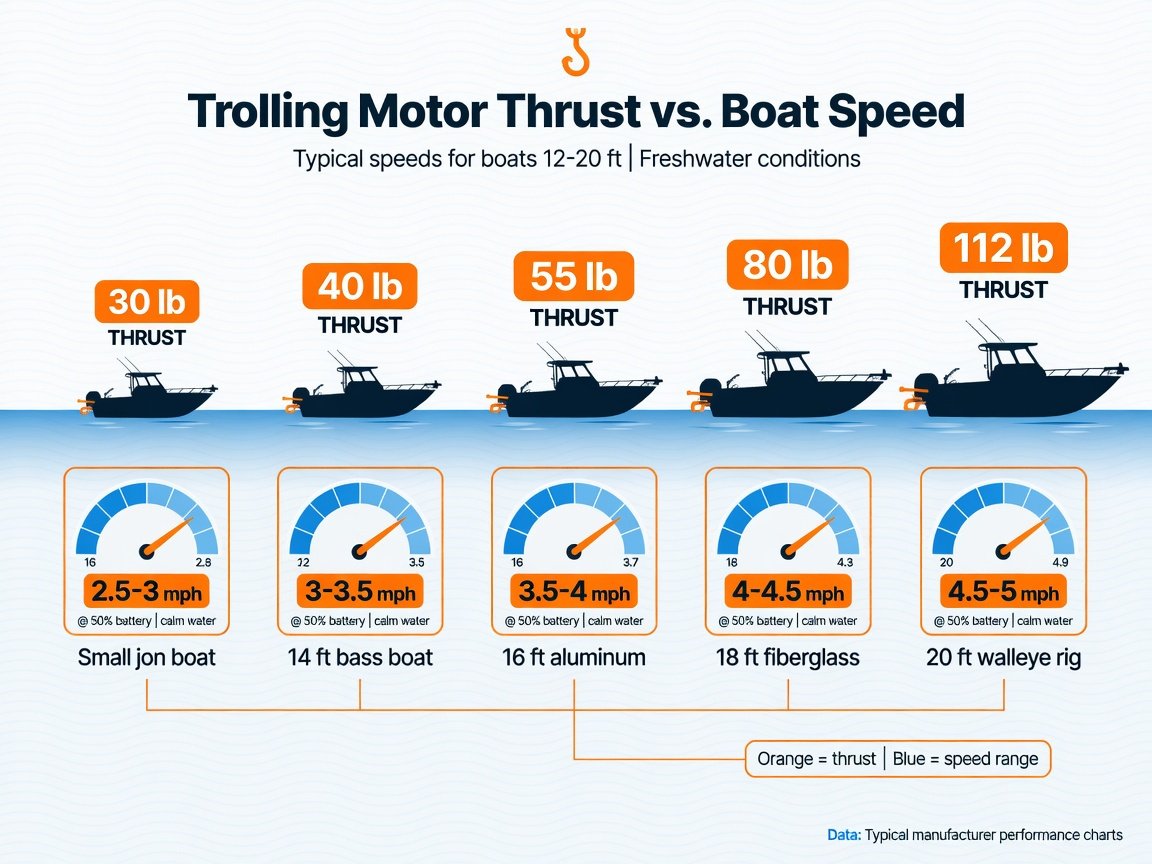
In genuinely ideal conditions — flat calm water, no current, properly matched load — most electric trolling motors top out between 3 and 5 mph. That ceiling doesn’t shift much regardless of how much thrust you add. A 30 lb thrust motor on a light kayak might hit 2.5–3 mph. An 80 lb motor on a well-matched bass boat might nudge 4.5–5 mph. The gap between those two setups in real-world conditions is often smaller than anglers expect.
What separates a good trolling motor setup from a frustrating one isn’t top speed — it’s how well the motor performs at the 1.5–3.5 mph working range where you actually fish. Holding a depth contour against light current, creeping along a weed line without blowing past it, or hovering on a structure while you work through it with a drop shot — that’s where trolling motor performance really shows up. The spec-sheet maximum is mostly theoretical. Focus your buying decisions on what the motor does at working speed, not how fast it claims to go.
How Does Thrust Rating Affect Your Trolling Motor Speed?
Thrust is the pushing force your motor generates, measured in pounds. More thrust means more potential speed — but the relationship is not linear. Doubling thrust does not double speed. Water resistance increases with velocity, which means each extra pound of thrust yields diminishing speed returns as you approach the motor’s ceiling. A jump from 50 lbs to 80 lbs of thrust won’t move your top speed from 4 mph to 6 mph. It’ll move it from 4 mph to maybe 4.7 mph.
What extra thrust does deliver is reserve power — the headroom to maintain reasonable speed when conditions deteriorate. A 55 lb motor that struggles at 2 mph in choppy water would cruise at 4 mph in calm conditions. The additional thrust keeps you mobile when a weaker motor would be nearly stationary. That’s what you’re buying when you size up, not a faster top speed on a perfect day.
The standard sizing guideline is 2 lbs of thrust per 100 lbs of total boat weight as a minimum. Most experienced anglers recommend targeting 3 lbs per 100 lbs for comfortable performance with a safety margin. Below the 2 lb minimum, you’ll hit the motor’s effective ceiling almost immediately and have no reserve for adverse conditions.
| Thrust Rating | Max Speed (Ideal) | Typical Working Speed | Best Suited For |
|---|---|---|---|
| 30 lb | 2.5–3.0 mph | 1.5–2.0 mph | Kayaks, canoes, small tenders |
| 40 lb | 3.0–3.5 mph | 2.0–2.5 mph | Jon boats, small aluminum hulls |
| 50 lb | 3.5–4.0 mph | 2.5–3.0 mph | Bass boats up to 1,000 lbs loaded |
| 55 lb | 4.0–4.5 mph | 3.0–3.5 mph | Mid-size bass and walleye boats |
| 80 lb | 4.5–5.0 mph | 3.5–4.0 mph | Larger aluminum, heavier fishing rigs |
| 112 lb | ~5.0 mph | 4.0–4.5 mph | Heavy fiberglass, pontoons |
Does Your Boat Weight Kill Trolling Motor Speed?
Weight is the most controllable variable in the trolling motor speed equation. Every pound you add increases water resistance and reduces forward speed. This isn’t a small effect. A 36 lb thrust motor paired with a combined load of approximately 520 lbs — boat, motor, gear, and two anglers — maxes out at around 3 mph in calm conditions. Add another 150 lbs of tackle, live well water, and extra battery and you’ll likely lose another half mph without any change to the motor itself.
Hull design creates a second layer of variation. A flat-bottom jon boat pushes a large wall of water and generates significant drag. A semi-V aluminum hull moves more efficiently through the same water. A deep-V fiberglass hull cuts cleanest of all. Two boats with identical thrust motors and identical total weight can produce noticeably different real-world speeds simply because of how their hulls interact with the water. When comparing trolling motor performance across different boats, hull type is a variable you can’t ignore.
Weight distribution matters too. A bow-heavy load creates more drag and reduces efficiency compared to a centered load sitting low in the hull. Experienced anglers pay attention to how their boats are trimmed — keeping the heaviest gear centered and as low as possible improves performance measurably. If your motor is consistently underperforming speed expectations, audit your load and distribution before assuming the motor needs to be upgraded.
⚠️ Pro Tip: Always calculate your total loaded weight — boat hull, motor, battery, gear, bait, and all passengers — before sizing a trolling motor. A motor that looks adequate on paper can be severely underpowered once everything and everyone is actually aboard.
How Much Do Wind, Current, and Waves Actually Slow You Down?
Environmental conditions are frequently the biggest speed variable of all — larger than thrust rating, larger than boat weight. In a 15 mph headwind, a motor that cruises comfortably at 4 mph in calm water can be reduced to just 0.5 mph at full throttle. That’s not an edge-case scenario. It happens on lakes and reservoirs regularly, and it’s the reason experienced anglers consistently recommend sizing up from the technical minimum when choosing a motor.
Current creates a similar problem, especially on rivers and tidal systems. Fighting a 2-knot current means your motor is spending most of its power staying in place rather than moving forward. On those days, even a well-sized motor feels like it’s barely working. Anglers who fish moving water need to factor current speeds into their thrust requirements — not just their boat’s dead-weight figure.
Waves compound both problems. When your propeller repeatedly breaks the surface or cavitates in turbulent water, propulsive efficiency drops sharply. Chop introduces rapid, unpredictable speed variation that makes precise positioning extremely difficult regardless of motor size. If you regularly fish exposed water where wind is a factor, selecting a motor with substantial thrust headroom is critical — the right setup for fishing in windy conditions involves both thrust rating and design features that help the motor handle rough water consistently.
Does Voltage Make Your Trolling Motor Faster — 12V vs 24V vs 36V?
Higher voltage systems don’t raise the 5 mph speed ceiling, but they do allow motors to reach and sustain that ceiling more reliably under real-world conditions. Voltage determines how much power can flow to the motor efficiently. A higher-voltage system delivers more watts to the prop without generating the excessive heat and current draw that shortens motor life and drags performance down in a 12V setup under heavy demand.
Practically speaking: 12V systems support motors up to roughly 55–70 lbs of thrust. Beyond that range, the current draw becomes impractical — a high-thrust motor on a 12V system runs hot, draws enormous current, and wears components faster. 24V systems support motors in the 80–101 lb thrust range with room to breathe. 36V systems are for the biggest motors — 112 lbs of thrust and above — common on large tournament bass boats and serious walleye rigs.
For performance under load, the difference between a properly matched 24V setup and an overworked 12V setup on the same boat can be substantial — the 24V motor holds 3.5–4 mph in conditions that reduce the 12V motor to 2 mph. If you’re weighing whether an upgrade is worth the investment for your setup, the detailed comparison of 12V versus 24V trolling motors covers the real-world performance differences and total cost tradeoffs in full.
How Do Electric Trolling Motors Compare to Gas Motors in Speed?
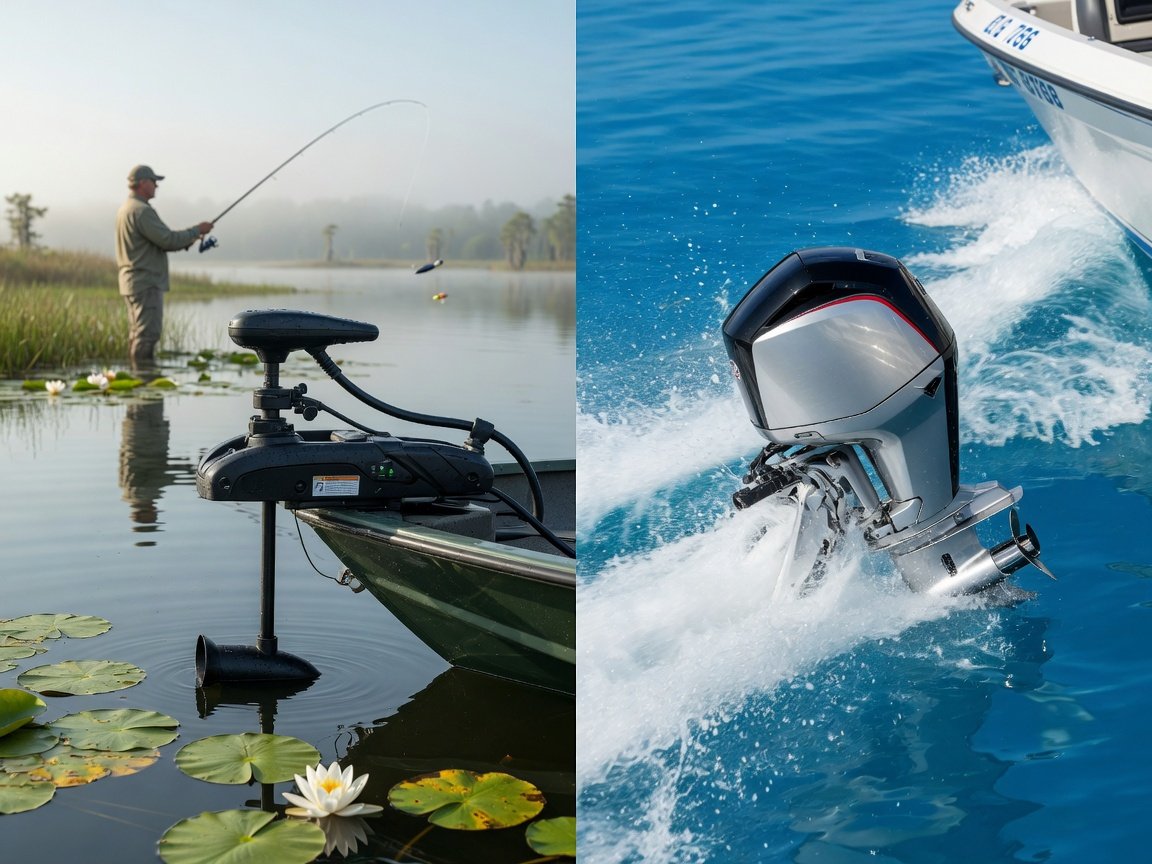
There’s no contest on raw speed: gas wins by a wide margin. A modest 2 hp gas engine outpaces a 50 lb electric trolling motor in pure velocity. Gas motors regularly push past 10 mph and scale into the 50+ mph range for performance outboards. Electric trolling motors hit a ceiling of approximately 5 mph regardless of their thrust rating. The technologies serve fundamentally different purposes and shouldn’t really be compared on speed at all.
Where electric trolling motors dominate is precision, stealth, and low-speed control. Gas motors are loud, produce exhaust, and are nearly impossible to feather accurately at the 1–3 mph speeds where most fishing happens. Electric motors run silently, produce no emissions at the boat, and allow micro-adjustments that a gas engine simply cannot replicate. At fishing speeds, electric wins in every dimension that matters to catching fish.
| Factor | Electric Trolling Motor | Gas Outboard Motor |
|---|---|---|
| Max Speed | 3–5 mph | 10–50+ mph |
| Precision at Low Speed | Excellent | Poor |
| Noise Level | Near-silent | Loud |
| Emissions at Point of Use | Zero | Exhaust fumes |
| Best Use Case | Fishing, precise positioning | Transit and covering distance |
| Fish Spooking Risk | Very Low | High |
| Operating Cost | Low (electricity) | Higher (fuel) |
Most fishing boats use both. The main outboard or kicker motor handles transit — getting you to the fishing spot quickly. The trolling motor takes over once you arrive, giving you precise, silent control for the actual fishing. Using a trolling motor to cover distance is the wrong application. It wasn’t designed for that, and treating it that way wears it out faster while delivering a frustrating experience. Think of it as your steering wheel on the fishing grounds, not your engine on the way there.
What Is the Thrust-to-Speed Formula Every Angler Should Know?
Thrust and speed don’t have a fixed conversion factor because too many variables are in play — hull shape, load distribution, water conditions, propeller design, battery state, and shaft angle all influence the final number. What the data does show is a consistent performance band for each thrust range, and a reliable sizing rule that applies across most setups.
The core formula: 2 lbs of thrust per 100 lbs of total loaded boat weight is your absolute minimum for reasonable performance. Most professionals recommend 3 lbs per 100 lbs as your working target — that gives you comfortable performance in normal conditions and useful reserve capacity when conditions get rough. A 1,200 lb loaded boat, for example, needs at least 24 lbs of thrust to move at all and ideally 36 lbs for practical fishing use. A motor in that range would be a 40–55 lb unit depending on what buffer you want.
One often-overlooked factor in the speed equation is how hard the motor works electrically. A motor running at full throttle doesn’t just burn twice the battery of one at half throttle — in many setups it burns three to four times as much. Understanding how many amps your trolling motor draws at various power levels is essential to trip planning and understanding why high-speed operation runs the battery down so quickly.
✅ Thrust Sizing Quick Reference
Minimum: 2 lbs of thrust per 100 lbs of total loaded weight
Recommended: 3 lbs of thrust per 100 lbs for real-world reserve capacity
Example: 1,000 lb loaded boat → minimum 20 lbs thrust, ideally 30 lbs
Result: Consistent 3–5 mph capability in typical conditions
What Do Real-World Trolling Motor Speed Tests Actually Show?
Controlled real-world testing consistently shows that actual speeds run 15–25% below the optimistic numbers manufacturers use in their marketing. The gap widens significantly the moment conditions deviate from ideal. That’s not a criticism of the motors — it’s just what happens when you apply a physics-constrained tool to the uncontrolled environment of real fishing water.
In a documented head-to-head test: a 36 lb thrust motor on a 14-foot aluminum boat carrying two anglers and a full day’s gear — approximately 520 lbs combined — recorded exactly 3.0 mph in flat calm conditions at full throttle. The same motor in a light 8 mph crosswind dropped to 2.2 mph. Against a 15 mph headwind, it could manage under 1 mph despite running at 100% power. Then the same motor was tested on a lightly loaded fishing kayak in the same calm conditions — it hit 4.2 mph. Same motor. 1.2 mph difference. Hull and load doing all the work.
Battery condition is another variable that regularly surprises anglers. A battery at 75% state of charge in cold weather delivers meaningfully less peak power than a fully charged battery at normal temperature. Speed at full throttle drops noticeably as the battery drains, meaning the “max speed” you see in the first 20 minutes isn’t what you’ll see in hour three. Knowing how long your trolling motor battery will actually last at various speed settings helps you manage power intelligently rather than running flat in the middle of the lake.
How Can You Maximize Your Trolling Motor Speed?
You can’t exceed the physics of your motor and hull combination, but you can ensure you’re getting everything the system is capable of delivering. These are the steps that consistently make the biggest measurable difference, ordered by impact:
- Right-size your motor to your actual loaded weight. Confirm you meet the 2–3 lbs of thrust per 100 lbs rule based on your real, fully loaded boat weight — not the hull dry weight listed in the spec sheet. An undersized motor running at 100% constantly is slower, hotter, and wears out faster than a properly sized one running at 70%.
- Inspect the propeller before every season. Nicks, dings, fouling, and deformation all reduce propulsive efficiency. A damaged prop can cost you 0.5–1.0 mph of real-world speed. If the blade edges look bent or the prop wobbles when you spin it, replace it before you go fishing. Learning how to spot the signs of a bad trolling motor propeller is a quick check that pays off every trip.
- Start every trip with a fully charged battery. Peak speed at full throttle is directly tied to battery voltage under load. A battery at 80% charge delivers less peak power than one at 100%, and the difference shows up in speed immediately. Charge fully before each trip and replace batteries that no longer hold a full charge.
- Reduce boat load wherever possible. Leave unnecessary gear, bait containers, and extra weight onshore. Every 100 lbs you remove from the boat gives your motor more performance headroom. This is the cheapest and most immediate speed upgrade available.
- Set motor shaft depth and angle correctly. The prop should be fully submerged at the shallowest angle possible. Running the shaft too steep reduces efficiency and allows the prop to cavitate. Most manufacturers publish the optimal depth for their specific models — follow it.
- Check and clean all electrical connections. Corroded terminals at the battery, motor connector, or circuit breaker create resistance that quietly robs voltage from the motor. A connection that looks fine visually can still have significant resistance. Clean, tight connections ensure the motor gets the full voltage the battery is providing.
What Are Experts Saying About Trolling Motor Speed in 2026?
The conversation in the marine industry has shifted noticeably over the past few years. Manufacturers are no longer competing primarily on thrust ratings or top-speed claims. The arms race in 2026 is about positional accuracy, power efficiency, and integration — the ability to hold a precise location, manage battery consumption intelligently, and sync with GPS and sonar systems. Raw speed isn’t the differentiator anymore.
From a power systems standpoint, lithium battery technology is producing the most significant real-world performance gains currently available. Lithium batteries maintain voltage more consistently under load than AGM or flooded lead-acid alternatives — meaning the motor sustains near-peak power throughout a long day rather than gradually slowing as the battery drains. For anglers who fish hard all day, that translates to more consistent speed in hours four through eight, not just in the first hour.
Looking ahead, GPS anchor and spot-lock technology continues to evolve as the defining feature category. For anglers who want the full combination of performance and precision positioning, the best spot-lock trolling motors of 2026 represent the current state of the art — motors that deliver competitive thrust with the kind of positional accuracy that makes speed almost irrelevant when you’re on fish.
Frequently Asked Questions About Trolling Motor Speed
How fast will a 36 lb thrust trolling motor go?
A 36 lb thrust trolling motor typically reaches about 3 mph with a combined load of roughly 500–520 lbs in calm water. On a lighter platform like a kayak, the same motor can reach closer to 4 mph. In any wind or current, expect that number to drop meaningfully. The 36 lb motor is well matched to small, light boats — not heavier aluminum fishing rigs where it would consistently underperform.
How long will a 55 lb thrust trolling motor run?
At full throttle on a fully charged 12V battery, a 55 lb thrust motor typically runs for 2–2.5 hours. Drop to half throttle and that extends to 4–6 hours. At the lowest speed settings, the same battery can last 8 hours or more. Runtime varies considerably based on battery age, ambient temperature, actual load on the motor, and whether you’re running against current or wind. Cold temperatures reduce battery capacity noticeably.
How fast should a trolling motor pull a boat?
For active fishing, most anglers work in the 1.5–3.5 mph range — fast enough to cover water and stay ahead of structure, slow enough to fish thoroughly and present lures effectively. Your motor should be able to reach 3–5 mph at full throttle, with your actual fishing speed well below that. If you can’t comfortably hold 2 mph in light conditions at less than full power, the motor is undersized for your boat.
How fast will a 62 lb thrust trolling motor go?
A 62 lb thrust motor typically reaches 4–5 mph in ideal conditions on a properly sized boat. Under a realistic combined load of 800–1,000 lbs in calm water, expect 3.5–4 mph. In chop or against current, speeds drop further. It’s a capable mid-range motor suited to most standard fishing boats and delivers solid performance throughout the day when paired with an appropriately sized battery.
Can a trolling motor go faster than 5 mph?
Very occasionally — a high-thrust motor on an extremely light hull in perfect conditions might briefly edge just above 5 mph. But 5 mph is the practical ceiling for electric trolling motors as a category. This isn’t a limitation of any particular manufacturer; it’s a constraint of how these motors are engineered and how electric propulsion interacts with water resistance at higher speeds. If you need reliable speed above 5 mph, your main outboard is the right tool for that job.
Does a 24V trolling motor go faster than a 12V motor?
Not significantly in absolute top speed — both categories approach the same 5 mph ceiling. The real difference is performance under load and in adverse conditions. A 24V motor reaches near-top speeds more easily, holds those speeds longer as the battery drains, and handles higher thrust ratings without overloading the electrical system. For larger boats or anglers who fish in challenging conditions regularly, 24V delivers noticeably better real-world performance even if the maximum spec looks similar on paper.
What Should You Do Next to Get the Most From Your Trolling Motor?
Trolling motor speed comes down to managing expectations and optimizing the controllable variables. Set a realistic ceiling — 3–5 mph in good conditions, less when weather and water work against you — and focus your energy on the factors you can actually influence: motor sizing, battery health, load management, and propeller condition.
Work through this sequence before your next trip:
- Calculate your full loaded boat weight — hull, motor, battery, all gear, and all passengers — and verify your motor meets the 2–3 lb per 100 lb thrust ratio
- Inspect the propeller for chips, bends, and fouling — replace if there’s any visible damage
- Check battery charge and health — a battery that no longer holds a full charge is quietly costing you speed every trip
- Clean all electrical connections at the battery terminals and motor connector
- Confirm your motor shaft depth is set so the prop runs fully submerged at the shallowest angle possible
- If your motor is a 12V unit running a boat that genuinely needs 80+ lbs of thrust, evaluate a 24V upgrade — the performance difference in real conditions is substantial
If you follow all of these steps and still find the motor underperforming, the almost certain cause is a mismatch between motor thrust and actual boat weight. In that case, the right-sized replacement will pay off across every trip from that point forward — not in raw speed, but in reliable, controlled performance exactly when and where you need it.