
The best trolling motor for a fishing kayak in 2026 is the Minn Kota Kayak Terrova — a purpose-built bow-mount motor offering 55 lbs of thrust, Spot-Lock GPS anchor, and a compact 36-inch shaft designed specifically for kayak decks. It gives kayak anglers hands-free boat control in wind and current without adding excessive weight or bulk.
- Kayak trolling motors should deliver 30–55 lbs of thrust; the standard rule is 2 lbs of thrust per 100 lbs of total load (boat + gear + angler).
- Lithium batteries now power over 60% of serious kayak fishing setups, according to Kayak Angler Magazine’s 2025 reader survey — they’re lighter, last longer per charge, and maintain consistent voltage output.
- GPS anchor (Spot-Lock / Anchor Lock) is the single most-requested feature among kayak anglers who upgrade from a basic trolling motor, per Outdoor Life’s 2026 gear report.
- Shaft length matters: most fishing kayaks need a 36-inch shaft — longer shafts risk prop strikes on flat-water sit-on-top hulls.
What Is the Best Trolling Motor for a Fishing Kayak?
Choosing the best trolling motor for a fishing kayak is different from choosing one for a bass boat or Jon boat. Kayaks have tight decks, shallow drafts, and weight limits that change the calculus entirely. A motor that’s brilliant on a 20-foot aluminum hull could be overkill — or even dangerous — on a 12-foot sit-on-top. According to Wired2Fish’s 2026 kayak motor guide, the three biggest mistakes kayak anglers make are choosing too much thrust, using a shaft that’s too long, and underestimating battery weight. Get those three things right and you’ll be well ahead of most buyers.
Some of the links in this article may be affiliate links. If you make a purchase through these links, we may earn a small commission at no extra cost to you. Thank you.
The kayak fishing market has grown dramatically in recent years. According to the American Sportfishing Association’s 2025 annual report, kayak fishing participation increased by 34% between 2020 and 2025, with powered kayak setups now accounting for nearly 40% of new kayak purchases. This boom has pushed manufacturers to develop purpose-built kayak motors — not just scaled-down boat motors — and the results are genuinely impressive. Models like the Minn Kota Kayak Terrova, Garmin Force Current, and MotorGuide Xi3 Kayak are engineered from the ground up for the unique demands of a fishing kayak platform.
How Much Thrust Do You Really Need for a Kayak Trolling Motor?
The golden rule in trolling motor sizing is straightforward: allow 2 lbs of thrust for every 100 lbs of total weight. That includes the kayak itself, your gear, your body weight, and anything else on the water with you. A fully loaded fishing kayak — angler included — typically weighs between 350 and 550 lbs. That puts most kayak anglers firmly in the 30–55 lb thrust range.
That said, wind and current add real-world complexity. Fishing exposed flats, tidal rivers, or big reservoirs with a sustained breeze means you’ll need more reserve power than flat-calm pond fishing. Kayak Guru’s 2026 buyer’s guide recommends sizing up by 20–25% if you regularly fish in moving water or coastal environments. A 55-lb motor on a 400-lb loaded kayak isn’t oversized — it’s smart headroom. Running at low-to-medium throttle also extends battery life significantly, so a 55-lb motor cruising at 40% capacity will outlast a 30-lb motor running flat out by a wide margin.
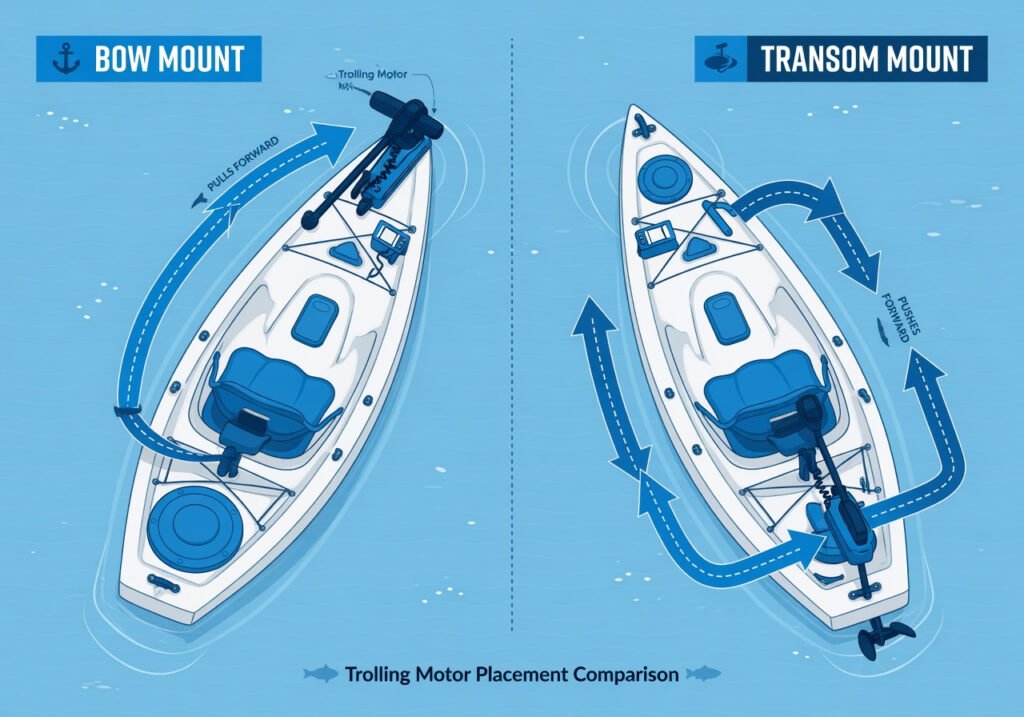
Bow Mount vs. Transom Mount: Which Is Better for a Fishing Kayak?
This is one of the most debated questions in kayak fishing, and the answer depends almost entirely on your kayak’s design. Transom mounts are the classic, budget-friendly choice — they clamp to the stern and push the kayak forward. They’re simple to install, easy to remove, and work well on traditional kayak designs with a flat, wide stern. Models like the Minn Kota Endura C2 and Newport Vessels Kayak Series are transom designs that have served anglers reliably for years.
Bow mounts offer superior steering and control. Because the motor pulls the kayak from the front rather than pushing from the back, you get much tighter turning radius and more precise positioning — critical when you’re working structure, stalking fish on flats, or making precise casts to cover. Bow mounts are the preferred setup for GPS-equipped motors like the Minn Kota Kayak Terrova and MotorGuide Xi3 Kayak, as their Spot-Lock and Anchor Lock features work most effectively when the motor is pulling from the bow. The trade-off: bow mounts are harder to install on kayaks without a dedicated bow mount platform, and many factory kayaks need aftermarket hardware for a clean fit.
| Feature | Bow Mount | Transom Mount |
|---|---|---|
| Control & Steering | Excellent — pulls kayak, tighter turns | Good — pushes kayak, wider turns |
| GPS Anchor Mode | Works best in this configuration | Less effective in current/wind |
| Installation Difficulty | Moderate to High — needs bracket | Easy — clamp-on mounting |
| Typical Price Range | $500–$2,000+ | $150–$600 |
| Best For | Serious anglers, GPS users, structure fishing | Casual anglers, flat water, beginners |
| Top 2026 Pick | Minn Kota Kayak Terrova | Minn Kota Endura C2 |
Is the Minn Kota Kayak Terrova the Best Kayak Trolling Motor Overall?
⭐ Our Top Pick — Best Overall Kayak Trolling Motor
Minn Kota Kayak Terrova | 55 lbs thrust | 36″ shaft | 12V | Spot-Lock GPS | Micro Remote IncludedThe Minn Kota Kayak Terrova is the most complete kayak trolling motor package available in 2026. Minn Kota took everything that made the full-size Terrova great — Spot-Lock GPS anchoring, Autopilot heading control, Drift mode, and the wireless micro remote — and packaged it in a frame purpose-built for kayak use. The 36-inch shaft is sized to suit most sit-on-top fishing kayaks, and the motor draws just 12V, keeping battery weight manageable. The safety switch kit included in the box adds a critical feature for kayak use: if the motor is triggered while you’re away from the boat, it automatically shuts off, preventing a runaway kayak scenario.
In real-world kayak fishing conditions, Spot-Lock is genuinely game-changing. Fishing a windy point or a tidal rip, you engage Spot-Lock with a button press and the motor actively fights wind and current to hold your GPS position. Reviewers across Outdoor Life, Wired2Fish, and Cast & Spear’s 2026 roundups all named the Kayak Terrova as their top overall pick, with consistent praise for the accuracy of GPS hold — typically within 5 feet — and the quality of the included micro remote. At 55 lbs of thrust, it handles loaded kayaks up to 500 lbs total weight with power to spare.

- Advanced GPS Navigation System with Spot-Lock Technology: Maintains precise position and allows automatic boat control through micro remote or One-Boat Network App
- Easy Stow/Deploy System with Auto Park: Get on the water faster with one-lever launch and stow operation and automatic motor positioning
- Digital Maximizer Technology: Extends battery life up to 5x longer with efficient power management for all-day fishing
- Compatible with One-Boat Network: Seamlessly connects with Humminbird fish finders and controls through iOS/Android mobile app
- Package Includes: 55 lb. thrust motor with 36 in. indestructible composite shaft (lifetime warranty) and built-in MEGA side imaging, Weedless Wedge 2 Prop, micro remote with lanyard, mounting hardware, and safety switch kit
Fishing saltwater? Opt for the Minn Kota Riptide Kayak Terrova (ASIN: B0FNZBD665), which features corrosion-resistant components rated for marine environments.
Is the MotorGuide Xi3 Kayak a Good Trolling Motor for Fishing?
🏆 Best Wireless GPS Bow-Mount — Runner-Up
MotorGuide Xi3 Kayak | 55 lbs thrust | 36″ shaft | 12V | GPS Anchor Lock | Wireless FOB RemoteThe MotorGuide Xi3 Kayak is the Minn Kota Terrova’s closest competitor, and for some anglers it’s actually the better choice. Where the Terrova leans into the full suite of Minn Kota’s proprietary i-Pilot features, the Xi3 Kayak keeps things a little more streamlined: GPS Anchor Lock (MotorGuide’s equivalent of Spot-Lock), a wireless FOB key fob remote, and a compact brushless motor that’s notably quiet — important when stalking fish in shallow water. Kayak Angler Magazine noted in their 2025 motor test that the Xi3’s brushless motor runs quieter than any of its competitors at low speeds, which matters more than most anglers realize when fishing pressured water.
The Xi3 Kayak is available in both freshwater and saltwater versions, with the 12V/55-lb/36-inch configuration being the sweet spot for most fishing kayaks. It also benefits from MotorGuide’s Pinpoint GPS system, which integrates with Humminbird fish finders if you’re already running Humminbird electronics. The trade-off versus the Terrova is the absence of Autopilot and Drift mode — features that matter on open water but are less critical for most kayak fishing scenarios. At its price point, the Xi3 Kayak offers exceptional GPS performance and build quality.

How Good Is the Garmin Force Current for Kayak Fishing?
🔌 Best Tech Integration — For Garmin Ecosystem Anglers
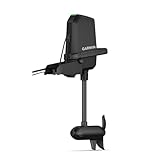
Garmin Force Current Kayak | 30 lbs (12V) / 50 lbs (24V) | Auto-voltage recognition | Wireless IntegrationThe Garmin Force Current is the most technologically ambitious kayak trolling motor in the 2026 market. Launched in late 2024, it was designed specifically for kayak use and introduced a clever dual-voltage system: connect a 12V battery and the motor automatically delivers 30 lbs of thrust; connect a 24V setup and it upgrades to 50 lbs — no manual switching required. For kayak anglers who want the flexibility to upgrade their power system over time without buying a new motor, this is genuinely useful.
Where the Force Current truly shines is integration. If you run a Garmin fish finder or chartplotter on your kayak — the Garmin Striker series being the most popular choice — the Force Current communicates with those units wirelessly. You can see motor status on your fish finder display, control speed from the chart screen, and even have the motor follow contour lines automatically. According to Garmin’s 2025 press release, the Force Current’s heading hold accuracy is within 3 degrees — impressive performance in a kayak-specific package. The motor comes with optional Power Steer foot pedals for hands-free directional control.
- Kayak trolling motor with legendary Force trolling motor reliability and performance
- Use the foot pedals, included on select bundles, for hands-free throttle and steering, or use the wireless handheld remote with point-and-go gesture steering
- Reduce clutter on deck; the throttle and steering pedals connect wirelessly to the motor and are designed to accommodate a wide variety of installation methods
- Connect your compatible smartwatch, and control throttle and steering from your wrist
- Unprecedented maneuverability; turn your boat quickly with full forward and reverse thrust in any direction

What Is the Best Budget Trolling Motor for a Kayak?
💰 Best Budget Pick
Minn Kota Endura C2 | Up to 55 lbs thrust | Transom Mount | 5-speed control | Battery meter includedNot every kayak angler needs GPS anchor mode, wireless remotes, or Bluetooth connectivity. If you fish flat-to-moderate water and just want reliable electric propulsion without the premium price tag, the Minn Kota Endura C2 has been one of the most trusted names in budget trolling motors for over a decade — and it remains excellent value in 2026. The Endura C2 is a straightforward transom-mount motor with a composite shaft, a simple 5-speed control handle, and a built-in battery meter so you can monitor charge without a separate gauge. It runs on 12V and is available in thrust ratings from 30 to 55 lbs.
For kayak use, the 30-lb or 40-lb version is typically sufficient for solo anglers in calm to moderate conditions, while the 55-lb covers heavier setups or windier environments. The Endura C2 lacks the bells and whistles of premium motors but makes up for it in simplicity and durability. According to consumer review aggregates on Amazon, the Endura C2 consistently earns 4.5+ stars across thousands of verified reviews, with reliability and value cited as the top reasons customers return to the brand. It’s the motor to recommend to a kayak angler just getting started with electric propulsion.
No products found.
Is Newport Vessels a Good Trolling Motor Brand for Kayaks?
🌊 Best Budget Pick for Saltwater
Newport Vessels Kayak Series | 55 lbs thrust | Corrosion-resistant build | Kayak-specific mounting kit includedNewport Vessels occupies a smart niche: affordable motors built with saltwater-capable materials. Their Kayak Series trolling motor is constructed with stainless steel, zinc, and magnesium components specifically chosen to resist the corrosive environment of saltwater and brackish fishing. At 55 lbs of thrust with a kayak-specific mounting bracket included in the box, it delivers a complete setup right out of the packaging — no hunting for compatible hardware. This makes it particularly appealing to kayak anglers fishing inshore coastal flats, tidal rivers, or estuaries without the budget for a Minn Kota Riptide.
Newport Vessels doesn’t compete with Minn Kota or MotorGuide on technology — there’s no GPS, no wireless remote, no advanced software features. But for the angler who wants a durable, saltwater-safe motor that gets the job done without complexity or a premium price, it’s a legitimate choice. Camphalfprice.com’s 2026 kayak motor roundup awarded the Newport Vessels Kayak Series a perfect score of 10 in the kayak-specific design category, noting that the included mounting hardware is better thought-out than most competitors at its price point.

What Battery Should You Use with a Kayak Trolling Motor?
Battery selection is arguably as important as motor selection — and it’s where many kayak anglers make expensive mistakes. The two main options are lead-acid (AGM or flooded cell) and lithium (LiFePO4). Lead-acid batteries are cheaper upfront — a 100Ah 12V AGM might cost $120–$180 — but they weigh 60–70 lbs, which is a significant burden on a kayak. They also deliver inconsistent voltage output as they discharge, meaning your motor loses power noticeably as the battery depletes.
Lithium batteries are the overwhelming preference among serious kayak anglers in 2026. A 100Ah 12V lithium (LiFePO4) weighs roughly 20–25 lbs — a saving of 40–50 lbs over lead-acid — and maintains consistent voltage all the way down to about 10% charge, so your motor performs the same at the end of the day as at the start. According to Redodo Power’s 2025 battery guide, a 50Ah lithium battery is sufficient for most kayak fishing trips up to 6–8 hours at mixed throttle. For full-day outings or high-thrust usage in current, a 100Ah lithium is the benchmark. The higher upfront cost ($250–$500 for quality lithium) is offset by a cycle life of 2,000+ charges versus 200–400 for lead-acid.
How Do You Install a Trolling Motor on a Fishing Kayak?
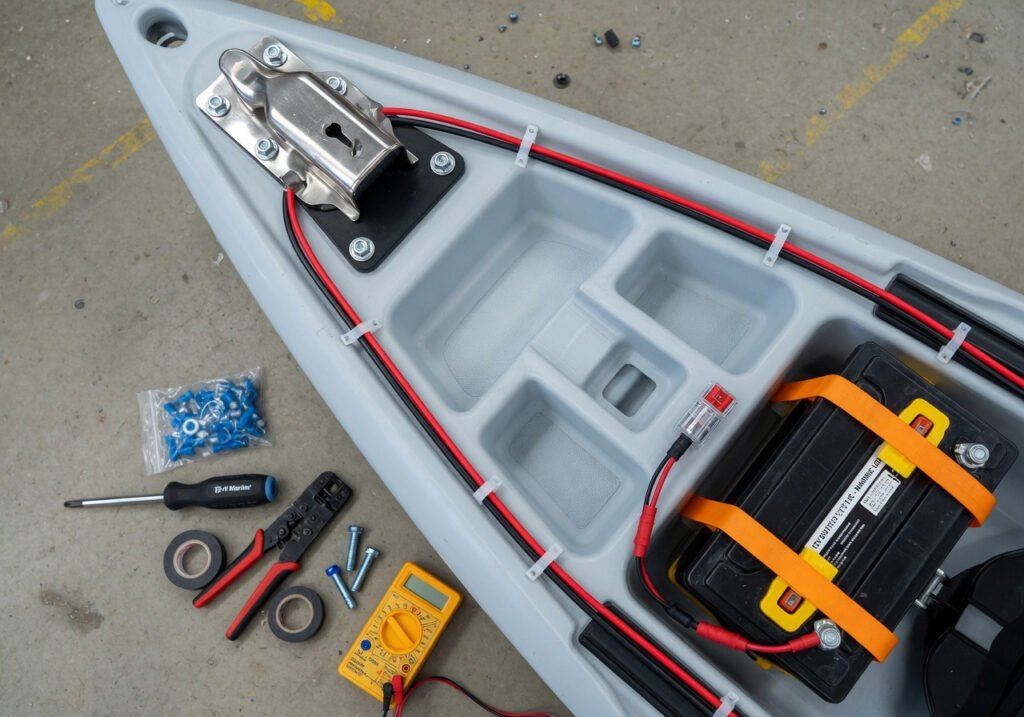
Installing a trolling motor on a fishing kayak is more involved than on a traditional boat, but it’s manageable for most DIY-minded anglers. The process differs between bow-mount and transom-mount configurations, but the core steps are similar. For transom mounts, most kayaks have enough of a stern lip to accept a standard clamp-on bracket. Bow mounts require a dedicated mounting platform — either a factory-installed track system (like those found on Native Watercraft or Old Town Sportsman kayaks) or an aftermarket bow mount platform kit.
According to BLD Marine’s 2026 trolling motor installation guide, the number-one installation mistake is insufficient fusing — always install a dedicated in-line fuse between battery and motor, sized to the motor’s maximum draw. For a 55-lb 12V motor drawing up to 52 amps at full throttle, a 60A fuse provides appropriate protection without nuisance tripping.
What Features Should You Look for in a Kayak Trolling Motor in 2026?
The kayak trolling motor market has advanced dramatically since the days of basic hand-tiller transom units. Here are the features worth prioritising in 2026, ranked by practical impact for kayak anglers:
- GPS Anchor Mode (Spot-Lock / Anchor Lock): Holds your kayak on a GPS-pinned position in wind and current. Genuinely transformative for sight fishing, structure fishing, and any scenario where precise positioning matters. Now available from sub-$500 models through to premium units.
- Short Shaft (36″): The correct shaft length for the vast majority of fishing kayaks. Longer shafts increase prop strike risk on shallow hulls. Always confirm with your kayak’s freeboard measurement.
- Lightweight Motor Design: Look for motors under 20 lbs for the motor head itself. The Minn Kota Kayak Terrova weighs approximately 17 lbs — manageable for a kayak deck without dramatically shifting trim.
- Wireless Remote: Frees you to cast, net fish, or hold a rod while the motor runs. Key fob or push-button remotes are the most practical format for kayak use.
- Variable Speed vs. 5-Speed: Variable speed (proportional power control) is quieter, more efficient, and allows fine power adjustment. Budget motors use 5-speed stepped controls — functional, but less refined.
- Saltwater Rating: If you fish salt or brackish water, explicitly confirm saltwater-rated components. Freshwater motors will corrode rapidly in marine environments, voiding warranties and creating safety risks.
- Safety Auto-Shutoff: Important for kayak use — some motors include a lanyard-triggered shutoff so a capsize doesn’t send your kayak motoring away on its own.
What Are the Biggest Trolling Motor Trends for Kayak Fishing in 2026 and Beyond?
The kayak trolling motor space is evolving faster than almost any other segment of fishing gear. The biggest shift driving 2026 innovation is the convergence of GPS precision, AI-assisted navigation, and lightweight power systems. Garmin’s Force Current kayak launch signalled that major marine electronics brands are taking kayak fishing seriously enough to engineer dedicated platforms rather than adapt boat products. Minn Kota’s response with the Kayak Terrova — a Terrova-spec motor in a kayak-native package — confirms the direction of the market.
Looking ahead to 2027 and beyond, three trends stand out. First, solar integration: several aftermarket companies now sell flexible solar panels compatible with kayak decks, trickling charge into trolling motor batteries during fishing sessions. Okmotech’s 2025 kayak power guide estimated that a 100-watt flexible solar panel can extend fishing range by 15–20% on a sunny day. Second, integration with wearable tech and smartwatches — expect to see Garmin and Minn Kota expand app and wearable control capabilities. Third, the rise of pod-drive systems like the Bixpy and Torqeedo kayak drives, which mount beneath the hull rather than at bow or stern, offer lower drag and better efficiency — though at a significantly higher price point. These alternatives are growing but haven’t yet displaced traditional trolling motors for most kayak anglers.
{{IMAGE_4}}
Frequently Asked Questions: Kayak Trolling Motors
Can you put a trolling motor on any fishing kayak?
Most fishing kayaks can accept a trolling motor, but not all. You need a kayak with sufficient stern or bow real estate for mounting hardware, a weight capacity that accommodates motor plus battery without approaching the hull limit, and enough freeboard (hull height above waterline) to allow a 36-inch shaft to reach proper depth. Many modern fishing kayaks — Old Town Sportsman, Native Watercraft Titan, Wilderness Systems Radar — are designed with motor-ready transoms or integrated motor tracks. Flat-hull sit-on-tops are the easiest to motorise; narrow sea kayaks and inflatable kayaks are generally not suitable.
How fast will a trolling motor push a kayak?
A 55-lb thrust trolling motor on a typical fishing kayak will achieve approximately 4–5 mph at full throttle in calm conditions. Speed varies significantly with wind, current, load, and hull shape. Most kayak anglers troll at 1.5–3 mph — well within the motor’s capabilities — and reserve high throttle for repositioning quickly. For context, kayaks are not designed for speed; the hull shape caps realistic water speed at around 5–6 mph regardless of motor power. Oversizing thrust beyond 55 lbs won’t make your kayak faster — it just wastes battery and adds weight.
How long will a trolling motor battery last on a kayak?
A 100Ah 12V lithium battery running a 55-lb motor at mixed throttle (averaging around 30% output) will typically last 8–12 hours on the water. At full throttle — which draws the maximum 52 amps — that same battery lasts roughly 2 hours. Most kayak fishing involves bursts of speed for repositioning and long periods of slow trolling or anchoring, so real-world runtime is usually at the higher end of these estimates. A 50Ah lithium is adequate for half-day trips; serious all-day anglers should carry a 100Ah minimum or bring a backup battery.
Is a 30 lb thrust trolling motor enough for a kayak?
A 30-lb motor is sufficient for a solo angler on a lightweight kayak (hull under 70 lbs, total load under 300 lbs) fishing in calm, sheltered water. It will feel underpowered in wind, current, or with a fully loaded heavier kayak. The step up to 45 or 55 lbs costs very little in weight or money on today’s market, and the difference in real-world performance is significant. For any situation involving tidal water, exposed lakes, or a kayak approaching 400+ lbs total, 30 lbs is too little. Size up to 45–55 lbs for a versatile setup that won’t leave you stranded.
Do trolling motors scare fish away from a kayak?
Electric trolling motors are significantly quieter than gas outboards and, in most fishing conditions, do not materially spook fish — especially in deeper water. In very shallow, clear water (under 3 feet), fish can detect low-frequency motor vibration at close range. Brushless motors like the MotorGuide Xi3 Kayak are quieter than brushed motors and are preferred for shallow-water stalking. In practice, the kayak angler’s paddle, hull movement, and accidental rod-on-hull contact are more likely to spook wary fish than the trolling motor. Approach fish with the motor off and drift or paddle for the final 30–50 yards in ultra-shallow situations.
What shaft length do I need for my fishing kayak?
Most fishing kayaks need a 36-inch shaft. This works for the typical sit-on-top hull profile with 8–14 inches of freeboard, allowing the prop to sit 6–12 inches below the waterline without excessive overhang. If your kayak has unusually high freeboard — some larger sit-inside designs — a 42-inch shaft may be needed. To check: measure from your motor mount point down to the waterline, then add 10–12 inches. That’s your minimum shaft length. When in doubt, 36 inches is the safe default for the vast majority of fishing kayak applications.
How to Choose the Right Kayak Trolling Motor: Final Verdict
Choosing the best trolling motor for your fishing kayak comes down to three questions: How much thrust do you need (use the 2 lbs per 100 lbs rule, then add 20% headroom)? What features matter most to you (GPS anchor, wireless remote, electronics integration)? And what’s your budget? From those answers, the right motor usually becomes obvious.
- Best Overall: Minn Kota Kayak Terrova —
— Full GPS package, kayak-native design, Spot-Lock precision.
Minn Kota Kayak Terrova Bow-Mount Electric Trolling Motor with GPS – 55 Lb. Thrust, 36 in. Shaft, Freshwater
- Advanced GPS Navigation System with Spot-Lock Technology: Maintains precise position and allows automatic boat control through micro remote or One-Boat Network App
- Easy Stow/Deploy System with Auto Park: Get on the water faster with one-lever launch and stow operation and automatic motor positioning
- Digital Maximizer Technology: Extends battery life up to 5x longer with efficient power management for all-day fishing
- Compatible with One-Boat Network: Seamlessly connects with Humminbird fish finders and controls through iOS/Android mobile app
- Package Includes: 55 lb. thrust motor with 36 in. indestructible composite shaft (lifetime warranty) and built-in MEGA side imaging, Weedless Wedge 2 Prop, micro remote with lanyard, mounting hardware, and safety switch kit
- Best Wireless GPS Runner-Up: MotorGuide Xi3 Kayak — — Brushless quiet motor, GPS Anchor Lock, excellent value vs. Terrova.
- Best for Garmin Users: Garmin Force Current Kayak —
— Deep ecosystem integration, auto-voltage recognition.
Garmin Force® Current Kayak Trolling Motor
- Kayak trolling motor with legendary Force trolling motor reliability and performance
- Use the foot pedals, included on select bundles, for hands-free throttle and steering, or use the wireless handheld remote with point-and-go gesture steering
- Reduce clutter on deck; the throttle and steering pedals connect wirelessly to the motor and are designed to accommodate a wide variety of installation methods
- Connect your compatible smartwatch, and control throttle and steering from your wrist
- Unprecedented maneuverability; turn your boat quickly with full forward and reverse thrust in any direction
$2,999.99Buy on Amazon - Best Budget: Minn Kota Endura C2 —
No products found.
— No GPS, no frills, proven reliability, excellent value. - Best Budget Saltwater: Newport Vessels Kayak Series — — Corrosion-resistant build, complete mounting kit, great price.
Pair whichever motor you choose with a quality lithium battery sized for your typical day on the water — 50Ah for half days, 100Ah for full — and you’ll have a setup that transforms your kayak fishing experience. The ability to hold position in wind, troll a crankbait along structure hands-free, or cover water without fatiguing your paddle arm is not a luxury in 2026 — it’s a genuine competitive and practical advantage for any serious kayak angler.