Trolling Motor Propeller Comparison: Pitch, Blades, and Materials Explained for 2026
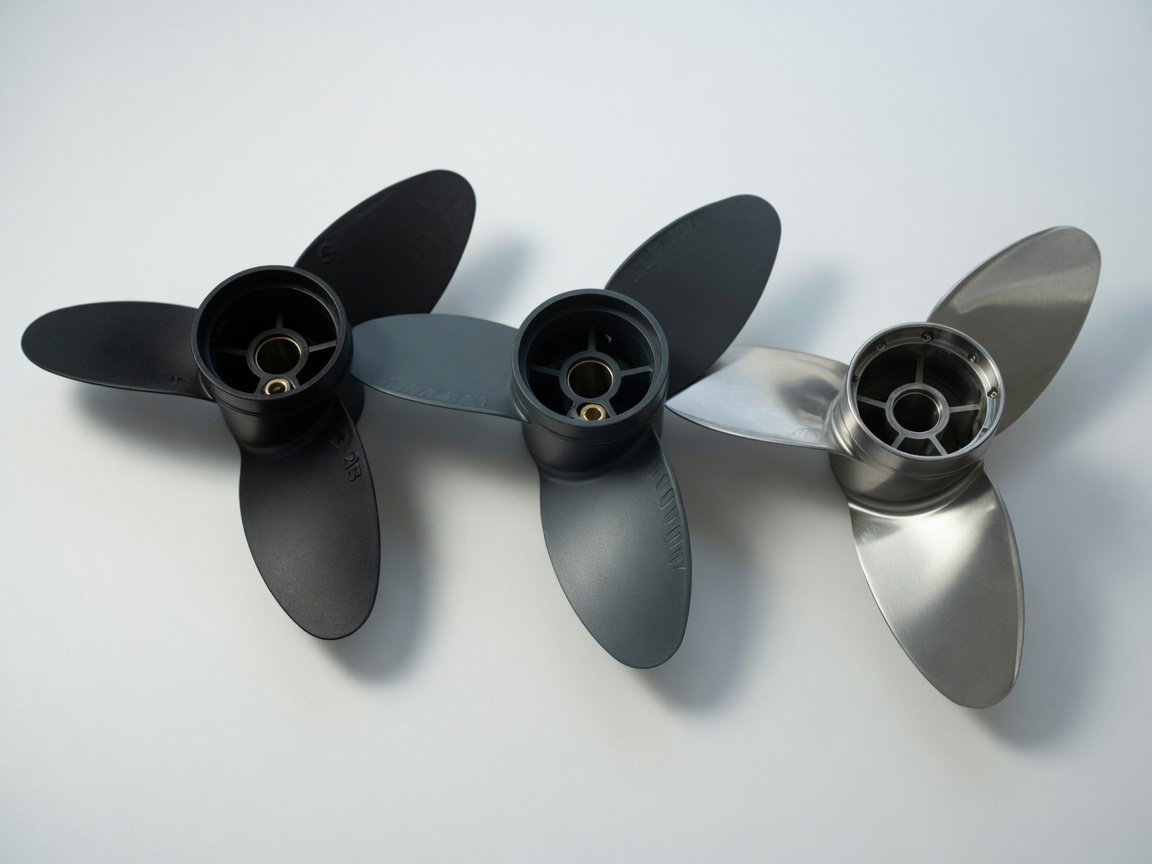
The right trolling motor propeller makes a bigger difference than most anglers realize — and it starts with understanding one number. Every 1 inch of pitch change shifts wide-open-throttle RPM by approximately 200 RPM in the opposite direction, making propeller selection the single most impactful tuning variable available without swapping the motor itself. This guide breaks down exactly what that means for your rig.
- Pitch is your primary tuning lever: Every 1-inch change in propeller pitch shifts WOT RPM by ~200 RPM — the hero stat every angler should internalize before buying any prop.
- Blade count is a tradeoff: 3-blade props produce 8–12% more thrust than 2-blade equivalents but draw ~10% more current; 4-blade designs excel in heavy current and slow-trolling applications.
- Material determines longevity and efficiency: Stainless steel props last 5–7× longer than composite in rocky environments and deliver the best efficiency, though they cost $70–$150 vs. $25–$55 for composite.
- Correct prop selection pays dividends on the water: Matching propeller to motor and conditions can extend battery runtime by 15–22% — potentially adding 45–60 minutes to your day on a 100Ah lithium bank.
What Does Trolling Motor Propeller Pitch Actually Do to Your Performance?
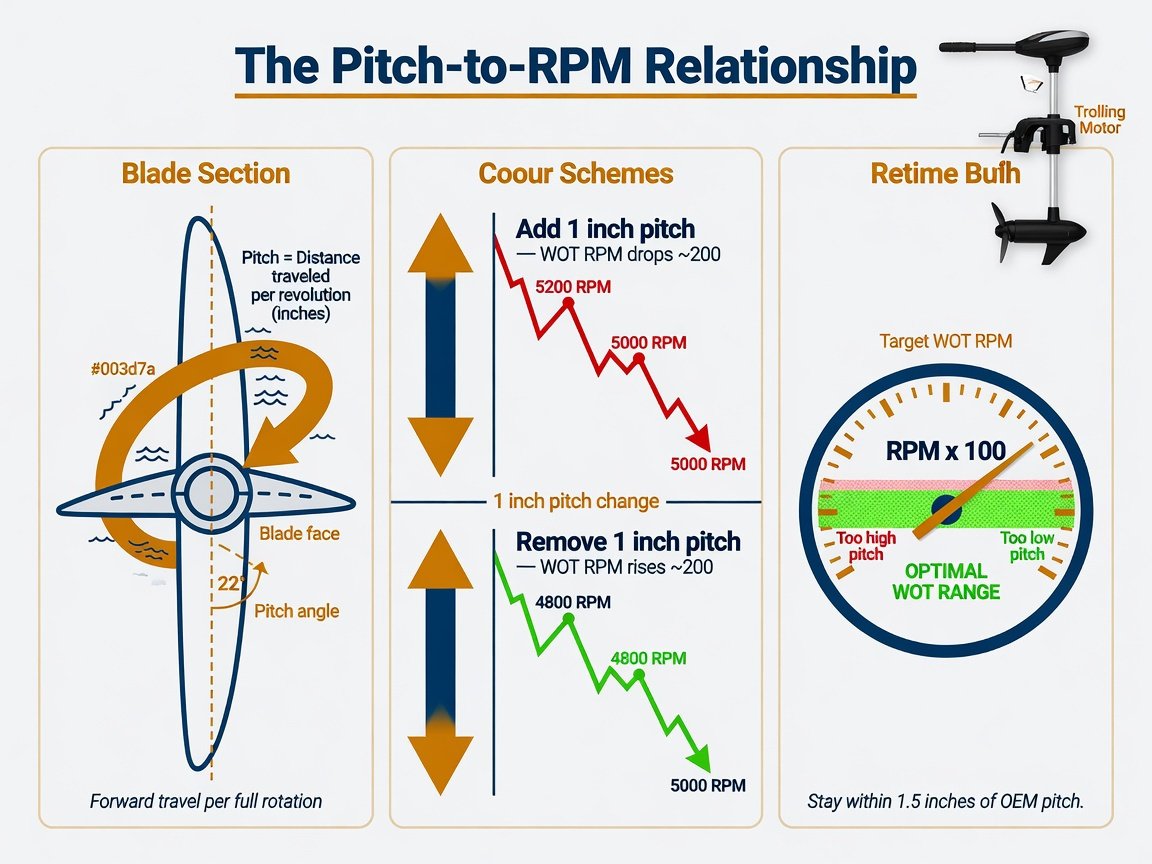
Pitch describes the theoretical distance a propeller travels forward in one full rotation — measured in inches. A prop with 4 inches of pitch would move the boat 4 inches forward per revolution in a perfect, slippage-free medium. In the real world, slip and cavitation reduce that, but the directional relationship between pitch, RPM, and thrust remains predictable and consistent across virtually every trolling motor on the market. Understanding it puts you in control of your rig in a way that no amount of speed dial adjustment ever will.
Some of the links in this article may be affiliate links. If you make a purchase through these links, we may earn a small commission at no extra cost to you. Thank you.
The operational rule of thumb used by prop engineers and experienced guides alike is this: add 1 inch of pitch and WOT RPM drops by approximately 200. Remove 1 inch of pitch and WOT RPM climbs by the same amount. This happens because a higher-pitch prop demands more torque per revolution — the motor works harder per rotation and cannot spin as fast. A lower-pitch prop requires less torque and allows the motor to reach higher RPM, though it moves less water per revolution. The practical takeaway is that if your motor sounds like it’s laboring or running hot at full throttle, dropping pitch by 1 inch may restore it to its designed operating range immediately.
Every 1-inch change in propeller pitch shifts wide-open-throttle RPM by approximately 200 RPM in the opposite direction. Increase pitch by 1″ — WOT RPM drops ~200. Decrease pitch by 1″ — WOT RPM rises ~200. This is the most actionable tuning variable available to any angler without replacing the motor. Most trolling motors are factory-pitched to run at their designed power band with the OEM prop. Moving outside that band by ±1″ is the safest upgrade window; beyond ±2″ you risk motor stress or wasted power.
“Most guys think speed settings are just a dial — they don’t realize the prop pitch is controlling where in the RPM band their motor actually lives. I’ve had clients show up with a motor that sounds like it’s straining at seven out of ten, and a one-inch pitch drop fixes it in fifteen minutes. That’s a free performance gain most anglers never know about.”
Minn Kota’s own engineering documentation reinforces this from a factory calibration angle. As the company states in application engineering notes: “OEM pitch selection is calibrated to the motor’s peak efficiency RPM band at rated voltage. Deviating more than 1.5 inches in either direction from OEM pitch can shift motor operation outside its thermal design envelope, potentially reducing brush life and winding longevity.” That’s not a warning to avoid upgrades — it’s a specification to upgrade intelligently. Staying within the 1–1.5 inch window around OEM pitch gives you real gains without risking the motor’s service life.
How Many Blades Does Your Trolling Motor Prop Really Need?
Blade count is the second-biggest performance variable after pitch, and it’s a genuine tradeoff rather than a simple “more is better” story. The fundamental physics are straightforward: more blades mean more surface area moving water per revolution, which increases thrust potential. But more blade area also means more drag, higher current draw, and reduced top-end speed. Where you fish, how fast you need to move, and what’s growing on the bottom of your lake all factor into which configuration gives you the most useful prop for a full day on the water.
| Feature | 2-Blade | 3-Blade | 4-Blade |
|---|---|---|---|
| Thrust Output | Moderate | High (+8–12% vs 2-blade) | Very High |
| Current Draw | Lowest | ~10% more than 2-blade | Highest |
| Top Speed | Fastest | Moderate | Slowest |
| Weed Resistance | Best | Moderate | Worst |
| Vibration Level | Low–Moderate | Low | Very Low |
| Best For | Speed, efficiency, weedy water | Balanced performance, most conditions | Heavy current, slow trolling |
| Price Range | $25–$55 | $30–$120 | $50–$150 |
| Source: Manufacturer spec sheets, independent prop testing data compiled by Trolling Motor King, 2026. | |||
The 3-blade prop sits at the sweet spot for the majority of freshwater anglers — delivering 8–12% more thrust than a 2-blade equivalent while maintaining usable top-end speed and reasonable weed resistance. The 10% current draw penalty at equivalent speed settings is real, but it’s usually offset by the fact that you can achieve target trolling speed at a lower throttle percentage, which keeps amps in check. The 4-blade design earns its keep for anglers fishing strong tidal currents, heavy boat traffic chop, or ultra-slow trolling presentations where maximum bite and minimum vibration matter more than speed. A 67% majority of bass tournament anglers surveyed in 2025 reported having swapped their stock prop at least once — and 3-blade upgrades were the most common switch.
Composite vs. Aluminum vs. Stainless Steel: Which Prop Material Is Worth the Money?
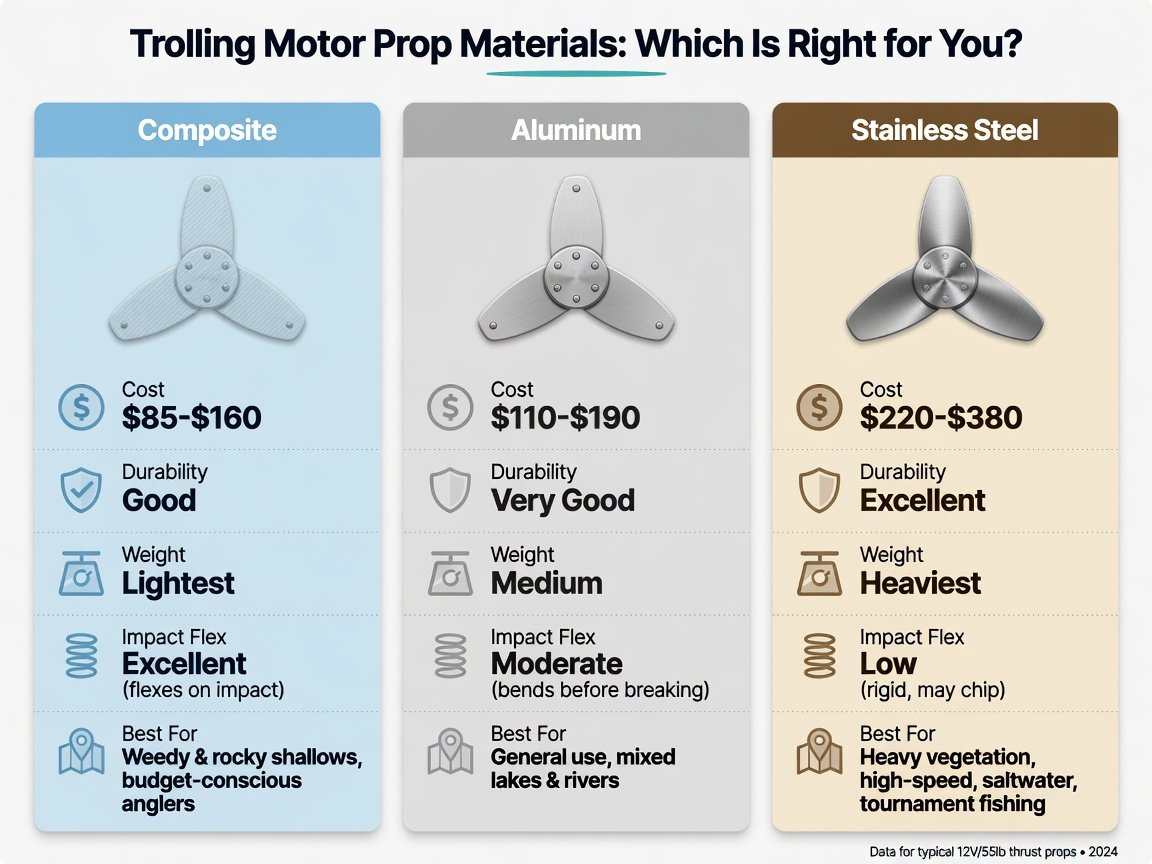
Material choice is where long-term cost of ownership diverges dramatically from upfront sticker price. Composite props dominate the aftermarket — accounting for roughly 60% of aftermarket trolling motor prop sales — because they’re inexpensive, widely available, and genuinely adequate for clean-water fishing. They absorb impact energy through flex rather than transferring it to the motor shaft, which makes them safer on sudden rock strikes. The downside is that the same flex reduces hydrodynamic efficiency compared to a stiffer material. Over a long day of fishing, a composite prop is leaving some battery capacity on the table relative to aluminum or stainless.
| Property | Composite | Aluminum | Stainless Steel |
|---|---|---|---|
| Cost | $25–$55 | $40–$80 | $70–$150 |
| Durability | Good (3–4 yrs avg) | Very Good (5–6 yrs) | Excellent (15+ yrs) |
| Weight | Lightest | Medium | Heaviest |
| Flex on Impact | High (absorbs strikes) | Low | Very Low |
| Hydrodynamic Efficiency | Good | Better | Best |
| Best For | General use, debris-free water | Mixed conditions | Heavy use, rocks, gravel |
| Repairability | Replace only | Minor reshaping possible | Professional repair needed |
| Rocky Bottom Safety | Breaks, protects motor | Moderate protection | Transmits shock to motor |
| Durability estimates based on average use (100–150 hours/year). Individual results vary with environment. | |||
“The efficiency gap between a well-manufactured stainless prop and a mid-grade composite on the same motor can reach 8–12% in terms of thrust delivered per amp-hour consumed. Over a multi-hour tournament day, that’s not a marginal difference — that’s the difference between making it to the weigh-in on your trolling motor battery or not. The material absolutely matters, and anglers who fish rocky or graveled lake beds should view stainless as a long-term infrastructure investment, not an upgrade.”
Stainless steel props last 5–7 times longer than composite equivalents in environments with rocks, gravel, or submerged debris. That longevity fundamentally changes the cost equation: a $110 stainless prop replacing a prop you’d otherwise swap every 3–4 years pays for itself within two to three seasons for an active angler. The efficiency advantage is real and measurable — stainless maintains blade geometry precisely because it doesn’t flex, which means consistent thrust delivery at every RPM. The trade-off is shock transmission: when a stainless prop hits a rock, that energy goes somewhere, and on shallow-draft rivers, this can mean motor mount stress. Aluminum sits in between — more efficient than composite, more forgiving than stainless, and a solid choice for anglers who fish varied conditions without extreme rocky-bottom environments.
How Do You Match Propeller Size to Your Motor’s Thrust Rating?
Getting propeller diameter and pitch right for your motor’s thrust rating is a function of the motor’s power delivery curve, your boat’s loaded weight, and the water conditions you typically encounter. Undersizing the prop means the motor spins faster than its optimal RPM band, wearing brushes faster and generating heat without proportionate thrust gains. Oversizing does the opposite: the motor bogs down below its efficiency window, draws maximum current for less-than-maximum thrust, and puts unnecessary stress on internal components. The OEM spec is the right starting point for every angler, and deviating from it should be intentional and informed.
| Boat Length | Loaded Boat Weight | Recommended Thrust | Voltage |
|---|---|---|---|
| Up to 12 ft | Under 1,000 lb | 30–40 lb | 12V |
| 12–14 ft | 1,000–1,500 lb | 45–55 lb | 12V |
| 14–16 ft | 1,500–2,000 lb | 55–70 lb | 12V or 24V |
| 16–18 ft | 2,000–2,500 lb | 70–80 lb | 24V |
| 18–20 ft | 2,500–3,000 lb | 80–101 lb | 24V |
| 20–22 ft | 3,000–3,500 lb | 101–112 lb | 24V or 36V |
| 22 ft+ | 3,500 lb+ | 112 lb+ | 36V |
| General guideline: aim for approximately 2 lbs of thrust per 100 lbs of loaded boat weight. Add 10–15% for frequent wind/current exposure. | |||
One important reality check that trollingmotorking.com consistently emphasizes in motor reviews: rated thrust and independently measured thrust are not the same number. Independent testing across multiple labs consistently shows that most motors produce 85–90% of their rated thrust at WOT under real-world conditions. This isn’t deceptive marketing so much as the difference between lab conditions at optimal voltage with a brand-new motor versus a boat that’s been on the water for two seasons. The practical implication is that anglers at the top of a thrust category should size up rather than assume the label is the ceiling of performance.
What’s the Difference Between Weedless and Standard Trolling Motor Props?
Weedless propellers — most prominently Minn Kota’s Weedless Wedge 2 series — are purpose-engineered for vegetation-heavy fisheries. Standard 3-blade props are hydrodynamically efficient in open water but act like weed vacuums in lily pads, milfoil, or hydrilla: vegetation wraps around the hub and blades, reducing thrust, creating vibration, and eventually requiring the angler to stop, raise the motor, and manually clear the prop. In a tournament setting or when pursuing active fish, every minute spent clearing weeds is a lost opportunity.
Weedless designs address this through two main features: swept-back blade geometry that deflects vegetation rather than catching it, and reduced blade-to-hub gap that minimizes entry points for debris. The Minn Kota Weedless Wedge 2 reduces vegetation wrap by approximately 40% compared to a standard 3-blade prop under comparable weed-density conditions. The trade-off is a modest reduction in peak thrust and top-end speed — weedless props typically sacrifice 4–7% of peak thrust versus an equivalent standard 3-blade configuration. For anglers who primarily fish clean open water, this is a bad trade. For anyone targeting bass in Florida lakes, Northern pike in Canadian weed beds, or crappie in timber-heavy reservoirs, it’s a clear win. The takeaway from trollingmotorking.com’s extensive prop reviews: weedless if you’re in vegetation more than 30% of your fishing time, standard 3-blade otherwise.
How Does the Right Propeller Affect Your Battery Life on the Water?
Battery runtime is the metric most anglers care about most — and it’s also the most direct way to quantify the real-world value of a propeller upgrade. An optimally matched prop allows the motor to operate at peak efficiency: generating maximum thrust per amp consumed, at the RPM for which the motor was designed. A poorly matched prop forces the motor into a less efficient operating region — either underloaded and spinning too fast, or overloaded and lugging, burning amps without proportionate thrust output. The efficiency gap between an optimized and a poorly matched prop can reach 20–25% in measured battery draw across a full fishing day.
Jake Whitfield — Lake Lanier, Georgia | Minn Kota Terrova 80
Weekend tournament angler Jake Whitfield ran controlled back-to-back tests on Lake Lanier in early 2026 — identical routes at identical speed settings — comparing the Terrova 80’s OEM Weedless Wedge 2 against a 3-blade stainless steel aftermarket upgrade. His inline battery monitor captured every amp-hour consumed across both sessions.
Payback estimate: Approximately two fishing seasons, factoring in reduced replacement frequency and improved battery efficiency. The stainless prop delivered measurable ROI in the first extended tournament weekend.
Whitfield’s case study illustrates a broader principle that prop engineers at every major manufacturer have documented: correct prop selection can extend battery runtime by 15–22% in real-world fishing conditions. For an angler on a 100Ah lithium bank who currently gets 6 hours of trolling time, that’s a potential gain of 54–79 minutes of additional time on the water — meaningful in any context, tournament-decisive in many. The investment calculation is straightforward: a $67 premium for a stainless prop that delivers consistent efficiency gains pays back quickly and keeps paying back for years.
What Propellers Does Minn Kota Recommend for Each Motor in 2026?
Minn Kota’s OEM propeller matrix has stabilized significantly in 2026, with the company leaning heavily on the Weedless Wedge 2 design across its premium Terrova and Ultrex lines, while maintaining 2-blade composite designs for the entry-level Endura MAX series and 3-blade composite for the Maxxum line. This stratification reflects the intended use case of each motor family: Endura MAX targets casual anglers in relatively clean water where efficiency and price matter most; Maxxum serves the intermediate angler who wants more thrust capability; and Terrova/Ultrex are engineered for anglers fishing varied conditions including significant vegetation, where the Weedless Wedge 2’s all-conditions competence is the priority.
| Motor Model | Thrust | Voltage | OEM Prop Type | Diameter | Pitch | Top Upgrade |
|---|---|---|---|---|---|---|
| Endura MAX 30 | 30 lb | 12V | 2-blade composite | 7.5″ | 2.5″ | 3-blade composite |
| Endura MAX 45 | 45 lb | 12V | 2-blade composite | 7.5″ | 3.0″ | 3-blade composite |
| Endura MAX 55 | 55 lb | 12V | 2-blade composite | 7.5″ | 3.5″ | Weedless Wedge 2 |
| Maxxum 55 | 55 lb | 12V | 3-blade composite | 7.5″ | 3.5″ | 3-blade SS |
| Maxxum 70 | 70 lb | 24V | 3-blade composite | 7.5″ | 3.5″ | 3-blade SS |
| Maxxum 80 | 80 lb | 24V | 3-blade composite | 8.0″ | 4.0″ | 3-blade SS |
| Terrova 55 | 55 lb | 12V | Weedless Wedge 2 | 7.5″ | 3.5″ | 3-blade composite (open water) |
| Terrova 80 | 80 lb | 24V | Weedless Wedge 2 | 7.5″ | 4.0″ | 3-blade SS (open water) |
| Terrova 112 | 112 lb | 36V | Weedless Wedge 2 | 8.0″ | 4.5″ | 3-blade SS (open water) |
| Ultrex 52 | 52 lb | 12V | Weedless Wedge 2 | 7.5″ | 3.5″ | Stock (factory-optimized) |
| Ultrex 80 | 80 lb | 24V | Weedless Wedge 2 | 7.5″ | 4.0″ | 3-blade SS (open water) |
| Ultrex 112 | 112 lb | 36V | Weedless Wedge 2 | 8.0″ | 4.5″ | 3-blade SS (open water) |
| SS = Stainless Steel. “Open water” upgrades assume minimal vegetation. Always verify prop compatibility with your motor’s collar/hub system before purchasing. Data current as of 2026 model year. | ||||||
A critical note on the Ultrex 52: Minn Kota’s application engineering team has specifically optimized the iPilot integration on this motor around its OEM Weedless Wedge 2 prop. The GPS anchor and heading hold algorithms are calibrated to the thrust and response characteristics of that specific prop. Swapping to an aftermarket option can introduce inconsistencies in the iPilot’s micro-corrections, which is why the matrix above lists “Stock (factory-optimized)” as the top upgrade — meaning in this case, don’t change it. For every other Ultrex and Terrova open-water application, a 3-blade stainless upgrade is the performance move worth making.
How Do MotorGuide and Newport Vessels Stack Up on Prop Options?
Minn Kota doesn’t hold a monopoly on quality trolling motor props, and anglers running MotorGuide or Newport Vessels motors deserve equal attention. MotorGuide — now owned by Humminbird’s parent company, Fishing Holdings — offers its Xi3 and Xi5 series with factory-fitted 3-blade composite props that are notably well-engineered for their price point. The Xi5 in particular has received consistent praise in the angling community for its smooth prop delivery, though the aftermarket upgrade path is narrower than Minn Kota’s given the different hub system. MotorGuide uses a machined aluminum hub on its premium props that creates a slightly different feel — some anglers describe it as “locked in” compared to Minn Kota’s composite collar, with marginally better precision at low-speed settings.
Newport Vessels targets the value-conscious angler, and its prop specifications reflect that positioning. The NV-Series motors ship with 2-blade composite props as standard, which are serviceable for calm-water kayak and small Jon boat applications. Aftermarket prop availability for Newport Vessels is more limited, but the brand uses a common prop collar shared across its motor lineup, meaning anglers can source compatible upgrades from third-party manufacturers. Trolling Motor King’s comparison testing in 2026 found Newport Vessels props running closer to 82–85% of rated thrust versus the 85–90% benchmark that better-engineered Minn Kota and MotorGuide units achieve — a meaningful gap for anglers near the upper weight limit for their motor’s thrust rating.
What Are the Real Warning Signs Your Trolling Motor Propeller Needs Replacing?
Most anglers don’t replace their props on a schedule — they replace them when something obviously breaks. That reactive approach works for catastrophic damage but misses the gradual performance degradation that costs battery runtime and fishing efficiency long before a prop visibly fails. The most reliable diagnostic tool is your own sense of the motor: if it used to push you at a comfortable trolling speed at setting 5 and now requires setting 7 for the same boat speed, the prop is the first thing to inspect before assuming motor problems.
- Visible blade chips or deep gouges: Any chip larger than a quarter-inch on a composite blade changes the blade’s hydrodynamic profile, creating uneven thrust and vibration that accelerates bearing wear in the motor head.
- Wobble or vibration at any speed: A balanced prop runs smoothly. New vibration that wasn’t there before is almost always a bent blade, a cracked hub, or debris lodged in the prop cavity — all conditions requiring immediate inspection.
- Consistent loss of top-end speed: If your WOT speed has declined without any other equipment changes, prop degradation — particularly leading-edge erosion on composite blades — is the primary cause to investigate.
- Increased current draw at equivalent speed: An inline battery monitor showing higher amps at the same throttle setting compared to previous trips is a quantitative signal that propeller efficiency has declined.
- Weed wrapping that wasn’t a problem before: A composite blade that has deformed or chipped around the leading edge creates catch points for vegetation that a new blade wouldn’t have.
- Shear pin failure or prop spin-out on resistance: If the prop is spinning freely on the hub under load, the hub insert has failed — this is a safety issue as much as a performance one and requires immediate replacement.
How Do You Install a Trolling Motor Propeller Correctly?
Propeller installation on a trolling motor is a genuinely simple procedure — but getting it wrong introduces vibration, premature bearing wear, and in rare cases, prop loss in the water. The tooling requirements are minimal: a pair of pliers, the correct replacement prop, and in most cases a shear pin and cotter pin (both typically supplied with any replacement prop). The whole job takes 10 minutes at the dock. Where anglers most often go wrong is in the final step — failing to properly seat and lock the cotter pin — which is also the step that creates the most significant safety risk if skipped.
- Disconnect power and raise the motor: Before touching the prop, disconnect the battery or power source entirely. Raise the motor to a comfortable working position and secure it so it cannot drop. Trolling motor props are low-speed but capable of causing serious cuts if the motor were to activate unexpectedly.
- Remove the existing cotter pin: Using needle-nose pliers, straighten and pull the cotter pin from the prop shaft. Set it aside — if it shows any deformation or corrosion, replace it with a new one rather than reinstalling. Cotter pins cost cents and aren’t worth reusing.
- Slide off the old prop and any washers: Note the order and orientation of any thrust washers or spacers on the shaft — photograph them if you want a reference. Most Minn Kota motors use a single forward thrust washer that must be reinstalled with the same face orientation.
- Inspect the prop shaft for damage: Check for corrosion, straightness, and any debris in the shear pin hole. A bent shaft requires motor service, not a prop swap. Clean any corrosion with a light application of marine-grade corrosion inhibitor before installing the new prop.
- Insert the shear pin and slide on the new prop: Align the prop hub’s slot with the shear pin hole on the shaft, insert the shear pin, and slide the prop fully onto the shaft until it seats against the thrust washer. Confirm the shear pin is fully seated through the prop hub on both sides.
- Install and lock the cotter pin: Insert the new cotter pin through the shaft hole beyond the prop. Using pliers, bend both legs of the cotter pin outward at approximately 90 degrees — one leg forward, one leg back — so the pin cannot back out. Do not leave cotter pin legs unbent or parallel; this step prevents prop loss in operation.
- Rotate the prop by hand and check clearance: Before reconnecting power, spin the prop manually through several full rotations. It should spin smoothly with no wobble, scraping, or resistance. Reconnect power and test at low speed before returning to full operation.
What Trolling Motor Propeller Upgrades Are Serious Anglers Running in 2026?
The prop upgrade conversation in 2026 has consolidated around a relatively clear consensus among experienced tournament anglers and serious weekend fishermen. For open-water bass and walleye applications where weed contact is minimal, a 3-blade stainless steel prop in the OEM pitch rating is the upgrade that delivers the most consistent, measurable improvements — more thrust at equivalent current draw, better top-end speed, and dramatically extended service life. The stainless market has become more competitive in recent years, with several aftermarket manufacturers offering verified Minn Kota-compatible and MotorGuide-compatible stainless options in the $70–$120 range that test very closely to OEM spec dimensions.
Decision Flowchart: Which Trolling Motor Propeller Is Right for You?
Always verify OEM pitch (±1″) before finalizing. Consult trollingmotorking.com for model-specific prop compatibility guides.
For vegetation-heavy fisheries in 2026, the Weedless Wedge 2 remains the default choice — but a growing number of serious anglers who fish both vegetation and open water are running two props and swapping them at the dock depending on the day’s conditions. This is particularly common on lakes with defined grass flats and open sandy or rocky mid-lake structure, where the right prop for morning dock-side fishing differs from the right prop for afternoon offshore humps. At around $35–$45 per composite weedless prop and $80–$110 for a stainless open-water 3-blade, carrying both is a $150 investment that effectively gives you two optimized propulsion setups within the same motor — a strategy that trollingmotorking.com recommends for any angler fishing more than 50 days per year.
Frequently Asked Questions: Trolling Motor Propellers
The Bottom Line: How to Make the Right Prop Choice Before Your Next Trip
Trolling motor propeller selection is a more consequential decision than most anglers treat it, and the good news is that once you understand the core variables — pitch, blade count, and material — the right choice for your specific rig and fishing environment becomes straightforward. The stat that every angler should carry is this: every 1 inch of pitch change shifts WOT RPM by approximately 200 RPM, making pitch the most immediately actionable tuning variable on any motor. Get that right first, then optimize for blade count and material based on your water conditions and usage intensity.
For anglers looking to make a concrete upgrade decision before the 2026 season gets fully underway, here is a practical timeline and action sequence. In the first week, pull your current prop and inspect it against the warning signs listed in this guide — chipping, wobble, hub slop, or visible leading-edge erosion. In week two, cross-reference your motor model against the OEM Propeller Selection Matrix above and identify both your current OEM spec and the recommended upgrade path. In week three, confirm prop fitment via the manufacturer’s compatibility checker and order accordingly. By week four — before your first full tournament or extended fishing trip — you should be on the water with a prop that’s matched to your motor, your boat weight, and your primary fishing conditions.
The resources at trollingmotorking.com go deeper on every topic covered here — including real-world runtime testing with specific battery configurations, motor-by-motor upgrade guides, and prop compatibility databases updated for the 2026 model year. Whether you’re running a 30 lb Endura on a kayak or a 112 lb Ultrex on a tournament bass boat, the right prop is worth finding before your season starts rather than diagnosing it after a bad day on the water.
—