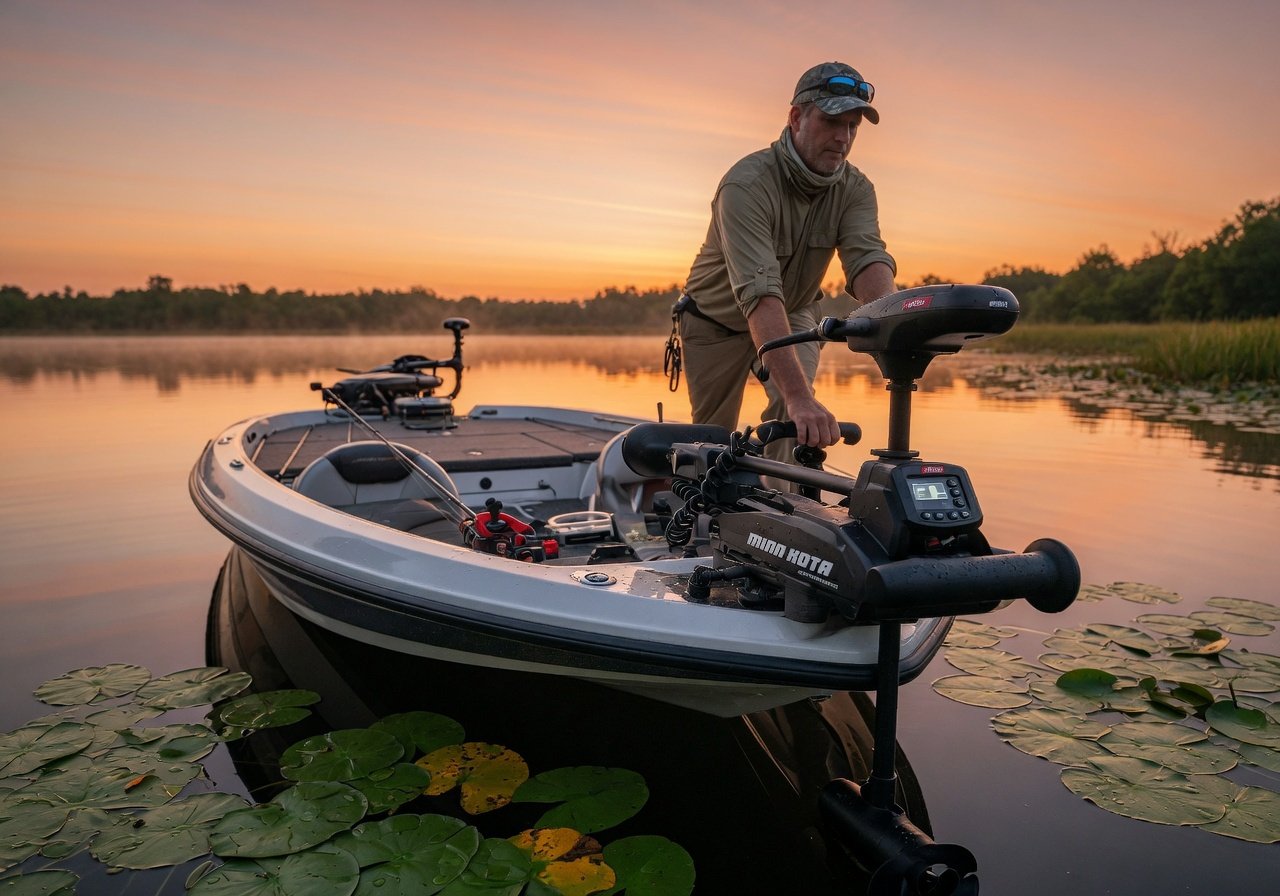
A trolling motor is a self-contained electric propulsion unit — motor, propeller, and controls in one package — that anglers mount on a boat to move quietly and precisely through the water without disturbing fish. Unlike a gas outboard, it runs on battery power and gives you fingertip-level control over speed and direction.
What You’ll Learn in This Guide
- How trolling motors actually work — the mechanics behind the silence and precision that fish can’t detect
- The five main types — bow-mount, transom-mount, engine-mount, kayak, and GPS-enabled motors, each built for a different style of fishing
- Key specs that matter — thrust (lbs), shaft length, voltage (12V/24V/36V), and battery run time explained in plain language
- How to choose the right motor in 2026 — a step-by-step sizing guide with brand comparisons and real-world case study data
How Does a Trolling Motor Actually Work?
At its core, a trolling motor converts electrical energy from a 12V, 24V, or 36V deep-cycle marine battery into rotational force that spins a propeller. When current flows through the motor’s windings, it creates a magnetic field that drives the armature — and that rotation is transferred directly to the prop. The whole system runs nearly silently, which is the entire point.
Some of the links in this article may be affiliate links. If you make a purchase through these links, we may earn a small commission at no extra cost to you. Thank you.
Modern motors use brushless motor technology more frequently than ever. According to Boating Industry Magazine (2025), brushless designs are now found in over 42% of new premium trolling motors sold in North America — up from just 18% in 2021. Brushless motors run cooler, last longer, and draw less amperage, which means more time on the water per charge. Most units also include a speed controller that regulates how much current reaches the motor, giving you anywhere from 1 to 10 (or more) distinct speed settings.
The head of the motor — the part that steers — can be turned manually, via a foot pedal, or autonomously through GPS-guided autopilot. That steering versatility is what separates a $200 trolling motor from a $2,000 one. At Trolling Motor King, we break down every performance tier so you know exactly what you’re paying for.
What Are the Different Types of Trolling Motors?
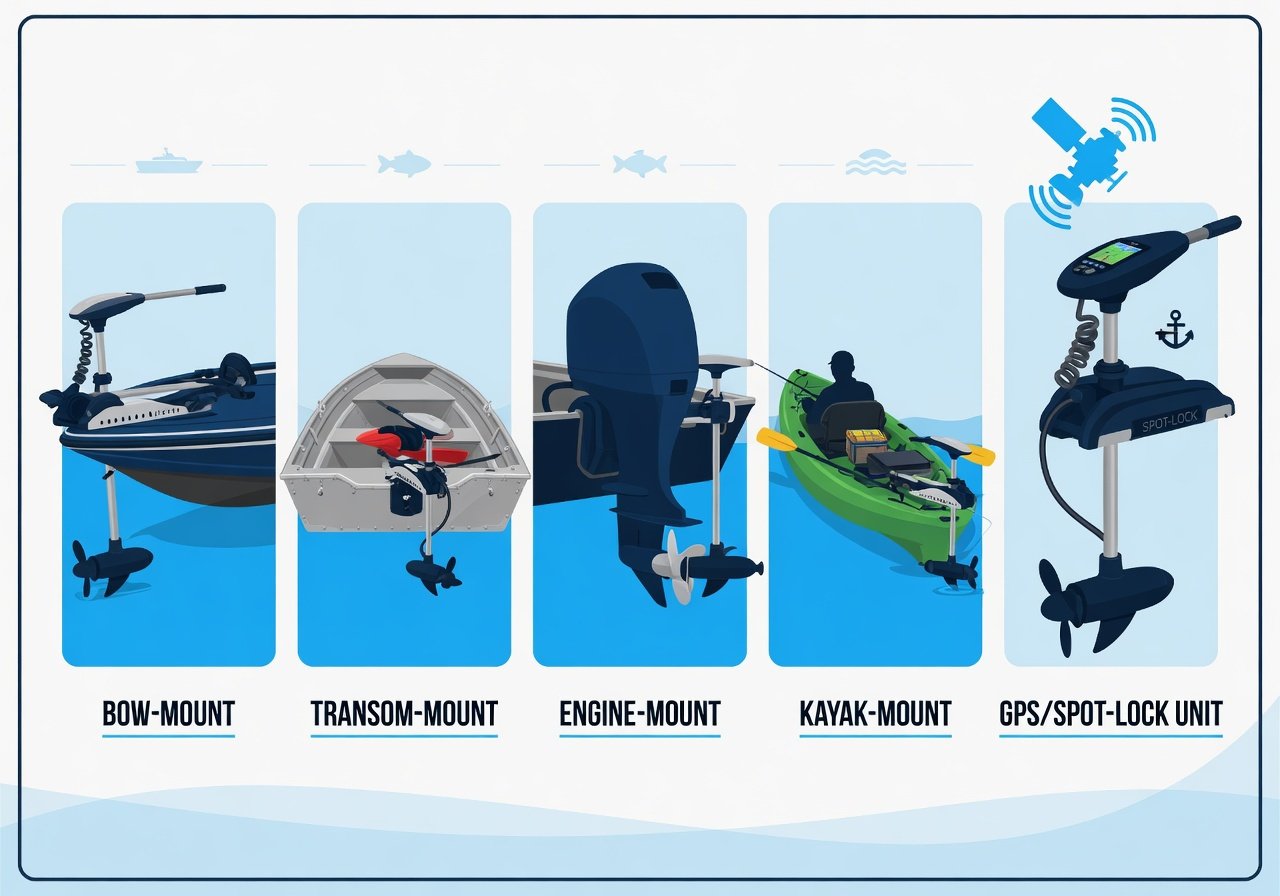
Not all trolling motors are created equal. The type you need depends almost entirely on your boat style, your fishing technique, and where you fish. Here’s a clear breakdown of the five main categories you’ll find in 2026.
| Type | Mount Location | Best For | Typical Thrust Range | Price Range |
|---|---|---|---|---|
| Bow-Mount | Front of boat | Bass fishing, precision boat control | 55–112 lbs | $400–$2,500+ |
| Transom-Mount | Rear of boat | Smaller boats, trolling, casual use | 30–86 lbs | $100–$700 |
| Engine-Mount | Attaches to outboard | Saltwater, large vessels | 70–180 lbs | $800–$3,000+ |
| Kayak / Canoe | Stern or side | Kayak anglers, solo fishing | 30–55 lbs | $150–$600 |
| GPS / Spot-Lock | Bow (usually) | Tournament anglers, structure fishing | 52–112 lbs | $900–$2,800+ |
Bow-mount motors are the most popular among serious freshwater anglers. Pulling the boat from the front gives you far more precise steering than pushing from the back — the boat follows the motor’s direction rather than swinging wide. Transom-mount motors are the entry point for most first-time buyers: affordable, simple to install, and perfectly capable on aluminum jon boats and small fishing boats under 16 feet. GPS-enabled motors with Spot-Lock technology — like Minn Kota’s Ultrex and Motorguide’s Xi5 — have revolutionized tournament fishing by holding your exact GPS position automatically, even in wind and current.
How Much Thrust Does a Trolling Motor Need?
Thrust is measured in pounds (lbs) and tells you how much pushing power the motor delivers. The industry rule of thumb is 2 lbs of thrust per 100 lbs of total boat weight — that includes the boat, motor, fuel, gear, and passengers. So a fully loaded 1,800 lb bass boat needs at least 36 lbs of thrust. But most experienced anglers recommend sizing up by 20–30% to handle wind, current, and waves without straining the motor.
Voltage also matters. A 12V system typically delivers up to 55 lbs of thrust. A 24V (two 12V batteries in series) gets you to 80 lbs, and a 36V system (three batteries) pushes 101–112 lbs. Higher voltage systems run more efficiently — they move the same amount of current at lower amperage, which generates less heat and extends battery life significantly. According to Minn Kota’s 2025 performance data, a 24V system at comparable thrust settings uses roughly 30% fewer amp-hours than the equivalent 12V motor running at full load.
Why Does Shaft Length Matter on a Trolling Motor?
Shaft length determines how deep the motor’s propeller sits in the water. If the prop breaks the surface, you lose efficiency and create noise — both terrible outcomes when you’re trying to sneak up on bass in a shallow cove. The correct shaft length depends on your boat’s deck height above the waterline.
The general guideline: measure from the motor’s mounting point down to the waterline, then add 12 inches. That gives you enough depth for the prop to stay submerged during normal operation. Bow-mount motors typically need longer shafts — 45 to 60 inches — because the bow deck sits higher off the water. Transom-mount motors usually work with 30 to 42-inch shafts. Research from Bassmaster‘s gear lab (2025) confirmed that improper shaft length is the number-one installation mistake made by first-time trolling motor buyers.
What Are the Top Trolling Motor Brands in 2026?
Three brands dominate the North American trolling motor market, each with a distinct identity and loyal following. Understanding the differences helps you spend your money wisely.
Minn Kota — Part of the Johnson Outdoors family, Minn Kota is the market share leader and the brand most associated with GPS Spot-Lock technology. Their Ultrex series integrates iPilot GPS control directly into a cable-steer foot pedal — a genuinely unique design. The Terrova and Riptide lines cover freshwater and saltwater respectively. According to a 2025 AnglerSurvey report, Minn Kota holds approximately 48% market share in the bow-mount category in the U.S.
Motorguide — Now owned by Garmin, Motorguide’s Xi series uses wireless Pinpoint GPS technology that integrates tightly with Garmin chartplotters. Tournament bass anglers who already run Garmin sonar often prefer Motorguide for seamless system integration. The Xi5 and Xi3 are its flagship GPS models.
Newport Vessels — The value-tier leader, Newport Vessels makes highly rated transom-mount motors in the $150–$400 range. If you’re outfitting a kayak or small jon boat, they’re hard to beat for price-to-performance. A 2025 Amazon Best Sellers analysis by OutdoorHub found Newport Vessels ranking #1 in transom-mount units sold for the third consecutive year.
What Are GPS and Spot-Lock Features — and Do You Need Them?
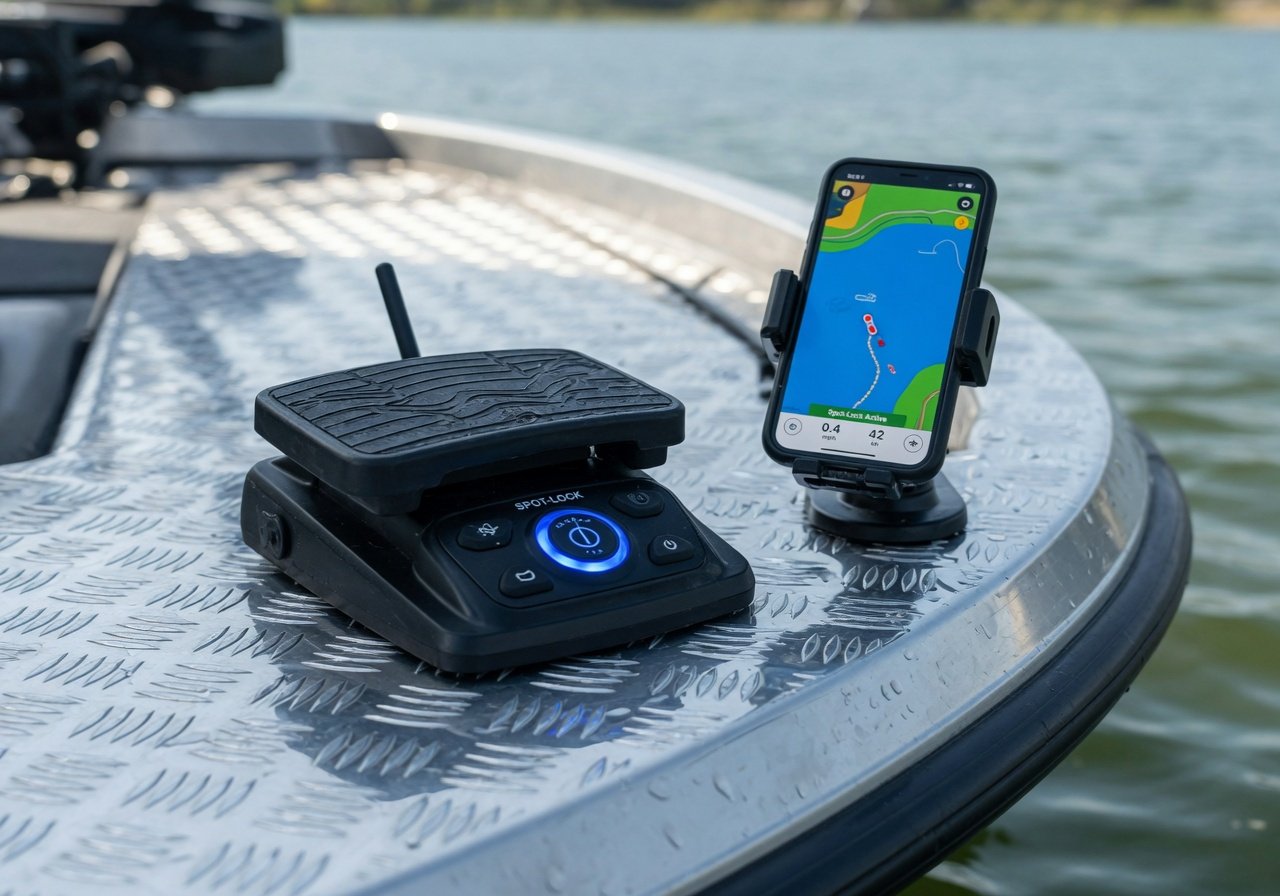
GPS-enabled trolling motors use satellite positioning to hold your boat in one precise location automatically — a feature Minn Kota markets as “Spot-Lock” and Motorguide calls “Pinpoint GPS Anchor.” The motor detects drift from wind or current and makes tiny corrections in real time to keep you on your spot. For anglers fishing over specific structure — a submerged hump, a channel edge, a dock — this is genuinely game-changing technology.
Beyond holding position, GPS motors offer Route Recording (retrace a productive path exactly), Heading Lock (maintain a compass bearing hands-free), and AutoPilot (follow a contour line or troll a straight course). A 2025 study published by American Sportfishing Association found that anglers using GPS trolling motors spent 34% more time with lines in the water compared to those using manual motors, because they weren’t constantly adjusting position.
Do you need it? If you’re a weekend recreational angler on calm lakes, a manual or foot-controlled motor does the job well. If you fish windy reservoirs, tournament bass circuits, or like to pick apart specific structure, GPS control pays for itself in fish caught and frustration avoided.
What Kind of Battery Does a Trolling Motor Need?
Trolling motors require deep-cycle batteries — not starting batteries. Starting batteries (the kind under your truck’s hood) are designed to deliver a huge burst of current for a few seconds and then recharge immediately. Deep-cycle batteries are built to discharge slowly and steadily over hours and then recharge fully without degrading. Using the wrong type will destroy a starting battery in a single outing.
You have three main battery chemistry options in 2026: Flooded Lead-Acid (FLA), AGM (Absorbent Glass Mat), and Lithium Iron Phosphate (LiFePO4). FLA batteries are the cheapest upfront but require maintenance and off-gas hydrogen during charging. AGM batteries are sealed, spill-proof, and handle vibration well — a solid middle-ground option priced $120–$250 per battery. Lithium batteries cost $600–$1,200 each but weigh 60–70% less than lead-acid equivalents and retain full capacity for 2,000+ charge cycles versus 300–500 for lead-acid.
For run time calculation, divide your battery’s amp-hour (Ah) rating by your motor’s expected amp draw at typical speed. A 100Ah lithium battery powering a 55 lb thrust motor drawing 40 amps at half-speed gives you roughly 2.5 hours of continuous run time at that setting. Most anglers aren’t running full throttle all day, so real-world run times are typically 20–40% longer than the math suggests.
How Do You Choose the Right Trolling Motor? A Step-by-Step Guide
Picking the right trolling motor doesn’t have to be overwhelming. Follow these six steps and you’ll land on the right motor for your boat, budget, and fishing style every time.
Case Study: How One Bass Club Upgraded Their Motors and Won More Tournaments
The Clearwater Bass Club in Central Florida — a 28-member club fishing Lake Toho and Lake Kissimmee — ran a documented motor upgrade program in 2024–2025. Fourteen members switched from manual bow-mount motors to GPS-enabled Minn Kota Terrova 80 lb units. The results over two full tournament seasons were tracked by the club’s tournament director, Ron Cabral.
The GPS group averaged 2.3 more keeper bass per tournament day compared to their pre-upgrade average. Their top-5 finish rate improved from 22% to 41% over 18 tournaments. Cabral attributes most of the gain to Spot-Lock: “We used to spend 15–20 minutes repositioning after wind pushed us off a drop-off. Now we set it and keep casting.” Battery costs increased (three members upgraded to lithium), but total fuel costs decreased because members relied less on the gas engine for fine positioning. The club estimated a net cost savings of $340 per member per season when factoring in reduced gas consumption.
✅ Case Study Verdict
The Clearwater Bass Club’s experience mirrors what Trolling Motor King hears from anglers across the country — GPS boat control isn’t a luxury feature for tournament anglers. It’s a time-on-target multiplier that pays back in fish caught and money saved on gas.
How Do You Install and Maintain a Trolling Motor?
Installing a transom-mount motor takes about 20 minutes. A bow-mount installation on a fiberglass bass boat typically takes 1–2 hours. Either way, the fundamentals are the same: secure the mounting bracket, run wiring directly to the battery (not through a fuse block meant for accessories), and connect a correctly rated circuit breaker in-line near the battery terminals.
Use marine-grade tinned copper wire — never automotive wire — and size it properly. A 12V/55 lb motor needs a minimum of 8 AWG wire for runs under 10 feet. A 36V system may need 6 or even 4 AWG depending on wire run length. Undersized wiring creates voltage drop, which reduces motor performance and generates heat that can start fires. Always consult the motor manufacturer’s wiring guide before running cable.
For maintenance, rinse the motor with fresh water after every saltwater use. Inspect the propeller for monofilament line wrapped around the shaft — this is the most common cause of bearing damage. Grease the shaft and mount pivot points at the start of each season. According to Minn Kota’s 2025 service data, motors that receive annual maintenance last an average of 7.2 years, compared to 3.8 years for those that receive no maintenance.
What’s New in Trolling Motors for 2026 and Beyond?
The trolling motor industry is moving faster than at any point in its history. Here are the trends Trolling Motor King is tracking most closely heading into late 2026 and 2027.
Wireless Foot Pedals have become the norm in the premium segment. Minn Kota and Motorguide both now offer fully wireless pedal systems with no cable to trip over. A 2025 dealer survey by Marine Retailer Association of the Americas found that 73% of bow-mount motors sold above $1,000 included wireless pedal capability — up from 44% in 2023.
Sonar Integration is the next frontier. Minn Kota’s Quest series, launched in early 2026, integrates Humminbird MEGA Live sonar directly into the trolling motor head — eliminating a separate transducer mount. Motorguide’s Garmin-powered Xi series achieves a similar result through the Garmin LiveScope system. These integrations mean anglers see live fish and bottom structure in real time, right from the motor that’s moving the boat.
Lithium-Native Motors — motors designed from the ground up to run on lithium battery chemistry — are coming. Traditional motors are engineered for the voltage sag characteristics of lead-acid batteries. Lithium batteries hold a flatter voltage curve, and next-generation motor controllers are being designed to take full advantage of that consistency for smoother speed control and better run-time estimates.
Frequently Asked Questions About Trolling Motors
Yes — and many kayak, canoe, and small jon boat anglers do exactly that. A 55 lb thrust transom-mount motor will move a 14-foot aluminum boat at 3–4 mph comfortably. However, trolling motors top out around 5 mph. If you need to cover large distances quickly or navigate fast-moving water, you’ll want a gas outboard as your primary and the trolling motor as your secondary.
It depends on your motor’s thrust rating, what speed you run, and your battery’s amp-hour capacity. A common setup — 55 lb thrust motor, 100Ah AGM battery, running at moderate speeds — gives most anglers 6–8 hours. Running at full throttle cuts that to 2–3 hours. Upgrading to a 100Ah lithium battery extends run time by 20–30% because lithium batteries discharge more evenly and deliver usable power deeper into their cycle.
Spot-Lock is Minn Kota’s branded name for GPS anchor mode. When you activate it, the motor uses GPS satellite positioning to hold your boat within a few feet of a specific location — automatically correcting for wind and current. Motorguide calls their version “Pinpoint GPS Anchor.” It’s one of the most impactful fishing innovations of the last decade, and it’s now available on motors starting around $900.
Not all of them — you must specifically buy a motor rated for saltwater use. Saltwater-rated motors (Minn Kota’s Riptide series, Motorguide’s Tour Pro Saltwater, etc.) use corrosion-resistant materials, sealed bearings, and coated wiring throughout. Using a freshwater motor in saltwater will corrode it rapidly — often within a single season. The motor’s product description will always specify freshwater, saltwater, or universal use.
Technically you can, but you absolutely shouldn’t. Car batteries are starting batteries designed for short, high-current bursts. Trolling motors draw moderate current over several hours — a deep-discharge cycle that destroys a starting battery’s plates within a few uses. Always use a dedicated deep-cycle marine battery rated for trolling motor use. It’ll save you money and frustration in the long run.
Most kayaks weigh 50–100 lbs loaded, which means 30–36 lbs of thrust is more than adequate. A 30 lb thrust 12V motor is the sweet spot for most sit-on-top fishing kayaks. Pedal-drive kayaks sometimes skip the trolling motor entirely, but for battery-powered propulsion on a kayak, look at compact units from Newport Vessels, Watersnake, or the Minn Kota Endura C2 30.
Ready to Choose Your Trolling Motor?
A trolling motor is one of the highest-impact upgrades any angler can make. It lets you fish quietly, position precisely, and stay on fish longer — all without burning gas or spooking the bite. Whether you’re outfitting a kayak with a compact 30 lb transom motor or upgrading your bass boat to a GPS-enabled 80 lb bow-mount unit, the right choice makes every trip better.
Here’s a simple implementation sequence to get you on the water with the right motor in under two weeks:
- Week 1, Day 1–2: Calculate your loaded boat weight and minimum thrust requirement using the 2 lbs per 100 lbs rule.
- Week 1, Day 3: Measure your shaft length requirement and decide on mount type (bow vs. transom).
- Week 1, Day 4–5: Read head-to-head reviews at Trolling Motor King for your target thrust and price range. Shortlist 2–3 models.
- Week 1, Day 6–7: Choose your battery chemistry and size a battery bank to your motor’s voltage and your target run time.
- Week 2, Day 1–3: Order motor, battery, charger, marine-grade wire, and a correctly rated circuit breaker.
- Week 2, Day 4–5: Install motor per manufacturer guide. Run a dock test before your first fishing trip.
- Week 2, Day 6–7: Hit the water. You’ll wonder how you ever fished without it.
At Trolling Motor King, we test, review, and compare every major trolling motor on the market so you don’t have to guess. Browse our full comparison guides, brand deep-dives, and battery pairing tools to find the exact setup that matches your boat and your fishing style.