Over 40% of boaters purchase the wrong trolling motor size for their vessel. The solution comes down to one formula: apply 2 pounds of thrust for every 100 pounds of total loaded weight, then layer in hull shape, voltage, and water conditions. Get those numbers right and your motor delivers quiet, efficient power from launch to takeout — every single trip.
- Industry data shows 40% of anglers run the wrong thrust rating — either overworking an underpowered motor or wasting battery capacity on one that’s too large for their rig.
- The universal baseline is 2 lbs of thrust per 100 lbs of fully loaded weight — a 2,000-lb vessel needs a minimum of 40 lbs of thrust to move reliably in calm conditions.
- Voltage defines your power ceiling: 12V suits boats under 2,000 lbs loaded; 24V handles the 2,000–3,500 lb range; 36V powers the heaviest rigs above 3,500 lbs.
- Wind, current, and hull design can add 10–25 extra pounds to your minimum thrust requirement — which is exactly why experienced anglers always size up, never down.
What Is the 2-Pounds-Per-100-Pounds Rule for Trolling Motor Thrust?
The 2-pounds-per-100-pounds rule is the industry’s universal starting point for every trolling motor purchase. It tells you the minimum thrust a motor must produce to move your rig at a comfortable working speed. A bass boat loaded to 1,500 pounds needs at least 30 pounds of thrust just to stay mobile in calm water. At 2,000 pounds your minimum jumps to 40 pounds. At 2,500 pounds you’re looking at 50 pounds before you’ve accounted for a single weather variable. Most anglers add a 10–20% buffer on top of that minimum, because the formula gives you a floor, not a ceiling. If your math says 40 lbs, buy a 55-lb motor. That headroom costs almost nothing compared to the frustration of a motor that can’t hold position in a 15-mph headwind two miles from the ramp. A complete trolling motor thrust breakdown by weight class shows exactly where each tier of boat lands and why the buffer matters at every level.
Some of the links in this article may be affiliate links. If you make a purchase through these links, we may earn a small commission at no extra cost to you. Thank you.
What the formula doesn’t capture on its own is dynamic drag — the extra resistance from hull shape, wind, current, and load shifts that simple static math ignores entirely. Think of the 2-lbs-per-100-lbs calculation as your absolute floor, not your recommended value. Field data from guide services and tournament circuits consistently shows that anglers who size up by one thrust tier above their calculated minimum report longer battery run times, more controlled drifting, and fewer emergency situations than those running at the exact minimum. The motor runs cooler, draws less of its available amperage on every outing, and extends its service life significantly over a five-year period. The single biggest purchase mistake in the trolling motor category isn’t buying too much power — it’s buying exactly enough and leaving zero margin for the conditions that actually show up on the water.
How Much Thrust Does Your Specific Boat Size Actually Need?
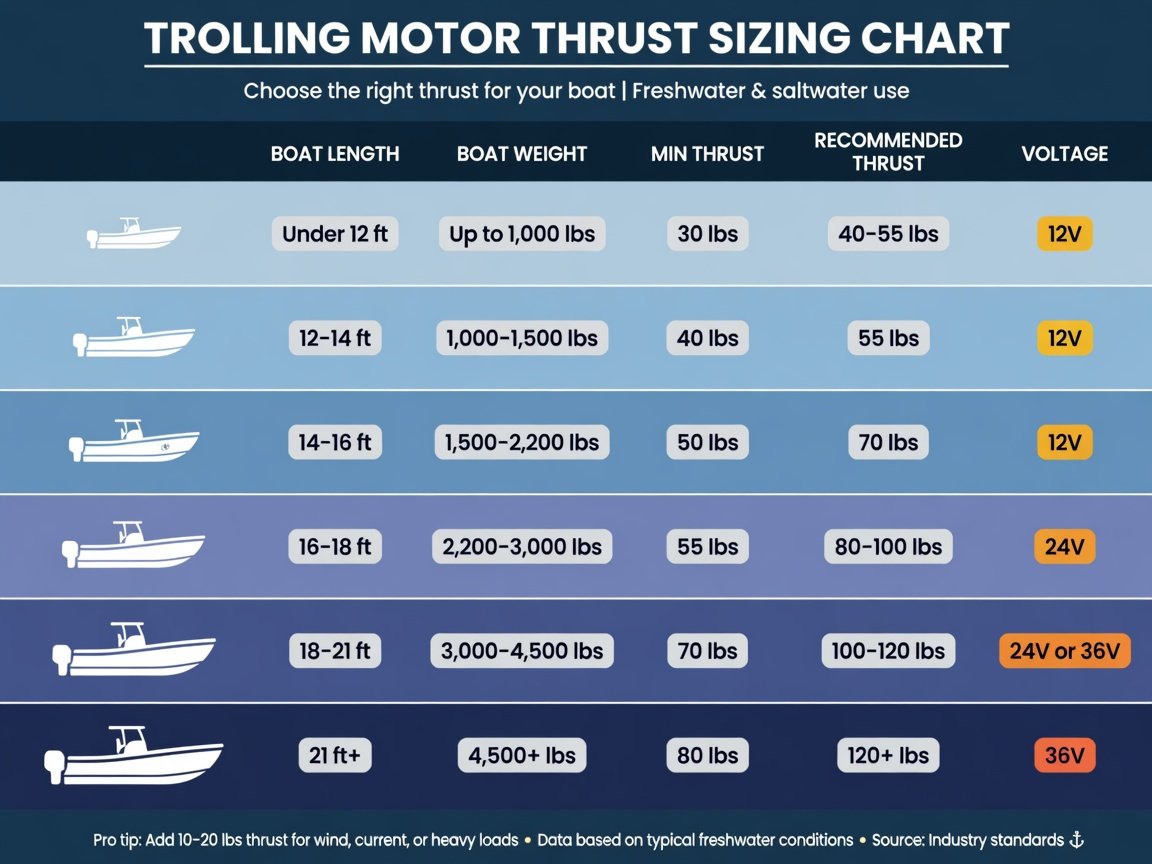
Different boat sizes fall into well-established thrust ranges based on both length and typical loaded weight. The chart below maps those ranges to the voltage systems and motor classes widely available in 2026. These figures assume moderate conditions — flat to light chop with no significant current. Adjust upward by 10–20 lbs if you regularly fish open reservoirs with afternoon thermals, coastal bays, or tidal rivers where conditions change quickly and predictably punish underpowered setups.
| Boat Length | Typical Loaded Weight | Minimum Thrust | Recommended Thrust | Voltage |
|---|---|---|---|---|
| Under 12 ft | Under 800 lbs | 24–30 lbs | 30–40 lbs | 12V |
| 12–14 ft | 800–1,200 lbs | 24–30 lbs | 40–55 lbs | 12V |
| 14–16 ft | 1,200–1,500 lbs | 30–40 lbs | 55–70 lbs | 12V / 24V |
| 16–18 ft | 1,500–2,000 lbs | 40–55 lbs | 70–80 lbs | 24V |
| 18–21 ft | 2,000–2,500 lbs | 55–70 lbs | 80–101 lbs | 24V / 36V |
| 21 ft+ | 2,500+ lbs | 70+ lbs | 101–112 lbs | 36V |
A 55-lb trolling motor is one of the most popular all-round choices on the market, and with good reason. It handles boats up to approximately 1,750 pounds reliably in moderate conditions, covers the sweet spot for most 14–16-foot aluminum and fibreglass fishing boats, and runs comfortably on a single 12V deep-cycle battery. Move above 1,750 pounds and you’ll want to step up to a 70-lb or 80-lb unit on a 24V system. Running a 55-lb motor on a heavier boat doesn’t just reduce speed — it overworks the motor and can cut your battery life by 30–40% compared to a correctly matched unit running well within its power band. That extra battery drain adds up fast on a full day of fishing.
How Does Hull Design Change Your Motor Power Requirements?
Hull shape is the variable most anglers overlook entirely when sizing a trolling motor, and it’s the one that causes the most post-purchase disappointment. A deep-V hull cuts through chop efficiently but creates significantly more drag than a flat-bottomed boat at slow trolling speeds. In practical terms, a deep-V bass boat weighing 1,800 pounds loaded needs roughly 15–20% more thrust than a flat-bottomed boat at the same weight to achieve the same working speed. That gap typically spans one full thrust tier on the market — the difference between a 55-lb and a 70-lb motor. Bay boats present a similar challenge: their high freeboard catches wind like a sail, and their wider beam creates more water resistance at trolling speeds. Most bay boats in the 17–20-foot range need 70–80 pounds of thrust just to hold reliable position in a moderate 10–15 mph breeze with a light coastal current running against them.
Flat-bottomed boats — jon boats, skiffs, and small aluminium fishing boats — are the most forgiving hull type for trolling motor sizing because they sit shallow and present minimal resistance to forward movement. A well-loaded 14-foot jon boat at 900 pounds responds well to a 40–45-lb motor even in light current, whereas a deep-V fiberglass boat at the same loaded weight might struggle with anything under 55 pounds in identical conditions. Pontoon boats fall somewhere in the middle: their flat underbody reduces drag, but their wide beam and high sides catch wind aggressively, and heavier models demand motors toward the top of their rated thrust range. Always treat hull type as a required modifier to the basic formula — not an optional footnote.
Which Voltage System Matches Your Boat Class?
Voltage is what gives a trolling motor its real-world performance ceiling. More voltage means more available amperage at any given thrust setting, which translates directly into longer run times and stronger sustained performance under load. The three standard voltage levels each serve a distinct boat class. A 12V system typically delivers up to 55 lbs of thrust and runs well for 4–6 hours of moderate active use on a quality 100Ah deep-cycle battery. A 24V system jumps into the 80–101 lb thrust range and can sustain 6–8 hours of comparable use on two batteries wired in series — a major upgrade for anglers who fish full tournament days. A 36V system handles the heaviest rigs, delivering up to 112 lbs of thrust from three batteries in series, making it the standard for tournament-spec pontoon setups and full-size bass boats in the 21-foot class. Pairing the right battery with your thrust rating is just as critical as the motor choice itself — an undersized or mismatched battery on a correctly rated motor will still leave you stranded before the fish stop biting.
One important nuance: a motor rated at 80 lbs on 24V will underperform that rating if connected to two weak, old, or mismatched batteries. Each battery in a multi-battery series system should be the same age, type, and capacity. Mixing a worn-out flooded lead-acid battery with a new AGM in a 24V setup is one of the fastest ways to cut effective run time in half and stress both batteries into early failure. If you’re building a fresh 24V or 36V system, buy your batteries as a matched set from the same production run. It’s a small upfront discipline that pays back in years of consistent performance on the water.
How Do Wind, Current, and Conditions Affect Your Thrust Needs?
Calm-water thrust ratings are tested under controlled ideal conditions. Real fishing rarely offers ideal conditions. Wind is the most common performance thief on the water — even a steady 10-mph headwind adds meaningful drag to any hull, and a 15–20-mph wind can make a correctly sized motor work hard just to hold position without any forward movement at all. The general guideline from professional guides and tournament anglers is to add a minimum of 10 extra pounds of thrust when you regularly fish open water, exposed reservoirs, or large lakes known for afternoon thermal winds. If you frequently fish tidal rivers or coastal flats where currents regularly run at 1–2 knots, add 15–20 pounds to your baseline figure. Offshore bay fishing in areas with regular 2-foot chop and combined wind-against-current conditions calls for at least 20–25 extra pounds above what flat-water math produces on its own.
Shaft length also plays into effective thrust delivery under rough conditions. When a motor runs in deeper chop with a shaft that’s too short, the propeller can break the surface and spin in air bubbles rather than water — a condition called cavitation that can cut effective thrust by up to 50% and risks motor damage over repeated exposure. A 36-inch shaft handles most conditions on standard 14–18-foot fishing boats, but anglers on pontoons, high-freeboard centre-consoles, or offshore-capable vessels routinely need 48-inch or longer shafts to keep the prop fully submerged when conditions get rough. Rated motor thrust is only delivered when the propeller stays properly submerged — the shaft spec and the thrust spec work as a system, not independently.
How Do You Calculate Your Total Boat Weight Correctly?
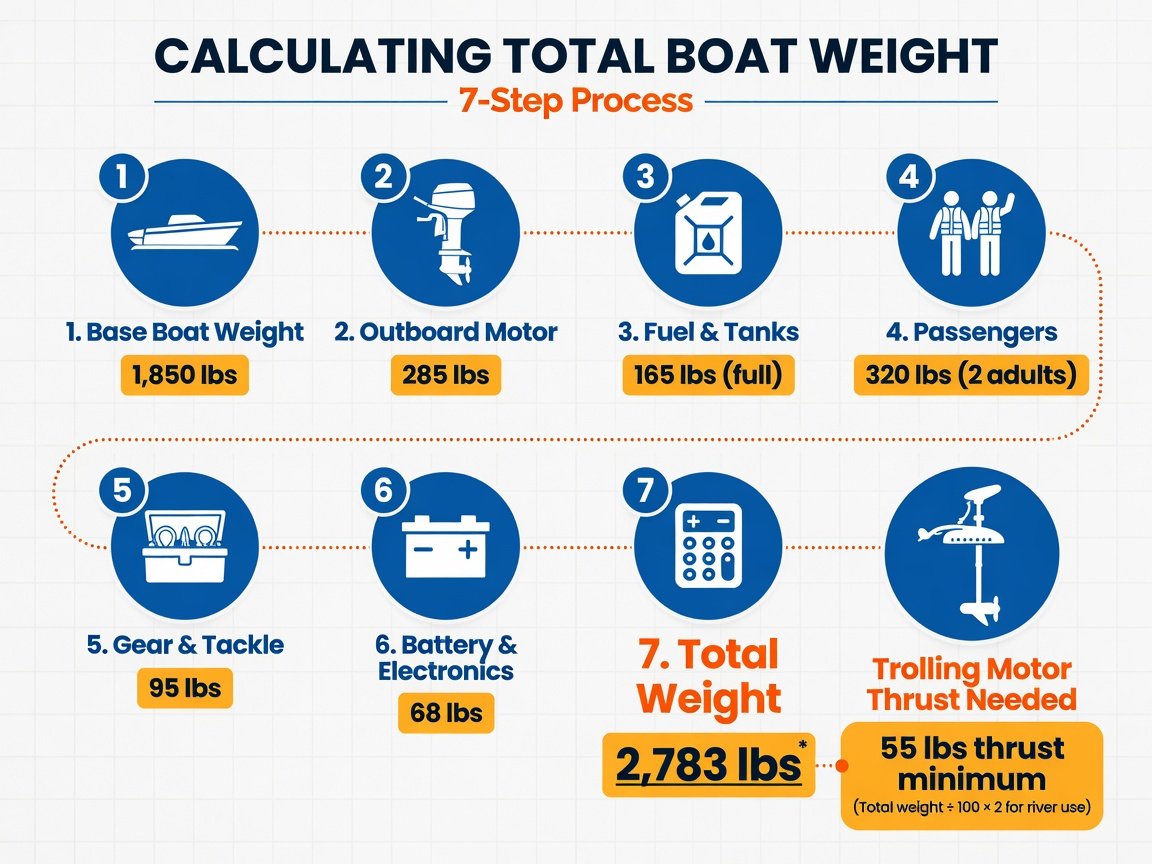
The most common thrust-sizing error isn’t choosing the wrong motor — it’s calculating weight incorrectly in the first place. Most anglers use the boat’s dry weight from the manufacturer’s spec sheet and stop there. That single number can underestimate total loaded weight by 40–60%, which throws off the entire thrust calculation. Here’s the complete seven-step process for getting the real number:
- Find your boat’s dry weight from the manufacturer’s label or spec sheet — hull and hardware only, no engine
- Add the weight of your outboard or inboard engine if not already included in the dry weight figure
- Add fuel weight — gasoline weighs approximately 6.1 lbs per gallon; a full 20-gallon tank adds roughly 122 lbs to your total
- Add passenger weight using 150 lbs per person as a conservative working average for your typical crew
- Add gear, tackle, and electronics — a fully loaded tournament bass boat can carry 100–200 lbs in equipment alone
- Add the weight of your trolling motor and battery bank — a 24V setup with two 100Ah AGM batteries adds 50–80 lbs to the total
- Divide your grand total by 100 and multiply by 2 to get your minimum required thrust in pounds
That seventh step gives you your calculated minimum. Now apply your modifiers before you finalize your choice. Add 15–20% of that minimum if you run a deep-V hull. Add 10 lbs if you fish exposed open water regularly. Add another 10–15 lbs if you frequently encounter significant current. A boat that calculates to 42 lbs minimum — fished from a deep-V hull on a wind-exposed reservoir — realistically needs 65–70 lbs of thrust to perform reliably across the full fishing season. That’s why the minimum is just the starting point and never the ending point of the calculation.
How Do Bass Boats, Jon Boats, and Pontoons Compare for Trolling Motor Thrust?
Each of the three most common freshwater boat types presents a distinct thrust profile driven by hull geometry, typical load, and how they’re used on the water. Bass boats are typically the most demanding per pound of weight because of their deep-V fiberglass hulls, significant gear loads, and the precision boat control required for serious fishing. A tournament-spec bass boat loaded to 2,200 pounds typically needs 80–101 lbs of thrust on a 24V system to hold position and maintain the kind of quiet boat control that doesn’t spook fish in shallow water. The 2026 market for high-performance bass boat trolling motors has shifted heavily toward GPS-integrated units with wireless foot pedal control and automatic spot-lock — features that raise current draw and effectively push anglers toward 24V or 36V setups even at mid-range boat weights.
Jon boats sit at the opposite end of the spectrum — lightweight, flat-bottomed, and low-drag, they are the most efficient hull type for a given thrust rating and the most forgiving for anglers who are new to motor sizing. Most jon boats in the 10–16-foot range fish comfortably with 30–55 lbs of thrust on a single 12V battery, and a well-loaded 14-foot jon at around 800 pounds runs reliably on a 40-lb motor in calm to moderate conditions. Selecting the right trolling motor for a jon boat involves different priorities than bass boat selection — compactness, shallow-water clearance, and simplicity of installation often matter as much as raw thrust numbers. Pontoon boats occupy the middle ground: their wide, flat hull reduces underwater drag, but their high freeboard and substantial total weight place them firmly in the 55–80 lb range, with larger tri-toon models pushing into 101-lb territory on 36V systems for reliable performance in open water.
What Shaft Length Should Pair With Your Thrust Level?
Shaft length and thrust rating work together as a system, but they answer entirely different questions. Thrust answers “how much power?” Shaft length answers “how deep does the propeller need to sit to use that power effectively?” The standard sizing method is to measure from your bow mount point or transom down to the waterline, then add a minimum of 12 inches to ensure the prop stays fully submerged in normal fishing conditions. For most 14–18-foot fishing boats that measurement puts you on a 36-inch shaft. High-freeboard boats, pontoons, and offshore-capable vessels often need 48-inch or 52-inch shafts regardless of thrust rating. Running a powerful 80-lb motor on a shaft that’s 6 inches too short produces cavitation in any chop, effectively cutting thrust by up to 50% and causing unnecessary heat stress on the motor over time. Getting shaft length right for your specific setup is as important as the thrust calculation — a perfectly rated motor on the wrong shaft will underdeliver every time conditions deteriorate.
What Does a Real-World Thrust Upgrade Actually Accomplish?
Consider a scenario that plays out regularly across the bass fishing community. An angler running a 16-foot aluminium bass boat fully loaded at 1,600 pounds had been using a 55-lb, 12V trolling motor for three seasons. He consistently ran his battery flat by early afternoon on tournament days and struggled to hold position in winds above 10 mph. After calculating his actual loaded weight and applying the hull modifier for his modified-V hull design, he upgraded to a 24V, 80-lb GPS motor with a 36-inch shaft. The results were measurable and immediate: active battery life extended from roughly 4 hours to over 7 hours on two matched 100Ah AGM batteries. Position holding in 15-mph winds went from a constant active task to hands-free. His tournament results in the back half of the season — historically his worst stretch due to afternoon wind — improved significantly because he could spend mental energy fishing rather than managing boat position with his foot pedal.
This pattern is consistent across the freshwater fishing community. The most common post-upgrade feedback from anglers who properly size up isn’t “the motor is too powerful” — it’s “I wish I’d done this two seasons ago.” A correctly sized motor runs at 50–70% of its available output during a typical fishing day rather than 90–100%, which keeps temperatures lower, reduces current draw from the battery, and extends the motor’s working life significantly. Industry experience suggests a motor running comfortably within its power band will outlast one running near its maximum output by three to five years in real-world use. Sizing up by one tier above your calculated minimum is almost always the smarter long-term investment in the category.
What Trolling Motor Technology Is Defining the 2026 Market?
The trolling motor market in 2026 has shifted meaningfully toward integrated intelligence, and that shift has direct implications for thrust and voltage sizing. GPS-based spot-lock systems — which use satellite positioning to hold a boat within a foot or two of a chosen point automatically — are now standard features on mid-to-high-end motors rather than premium add-ons. These systems draw a continuous high-current load to make micro-corrections in real time, which means the voltage sizing equation is more critical than it was five years ago. An angler running spot-lock on a 24V system all day needs a battery bank sized for that sustained draw across 8–10 hours of use, not just the motor’s rated thrust output on paper. Wireless remote controls and integrated sonar links are also now standard on most major brand offerings, reducing the footprint of physical cables and foot pedals on the front deck — a quality-of-life improvement that matters on a long tournament day.
Brushless motor technology is also making significant inroads at the performance end of the market in 2026. Brushless trolling motors run cooler, more efficiently, and with less electromagnetic interference than traditional brushed units — all of which matters when fish finders, GPS plotters, and live-scope sonar are running simultaneously on the same electrical system. The efficiency gains from brushless technology translate directly into extended battery run times at equivalent thrust ratings, often adding 15–25% more usable time per charge compared to a brushed motor at the same specifications. Industry analysts expect brushless technology to become standard across all thrust classes by 2027–2028, making motors purchased in 2026 at the brushless tier a particularly future-proof investment for anglers planning to hold their setup for several seasons.
Frequently Asked Questions About Trolling Motor Thrust and Boat Sizing
How big of a boat will a 55-lb trolling motor push?
A 55-lb trolling motor handles boats up to approximately 1,750 pounds of total loaded weight reliably in moderate conditions. For heavier boats or consistently rough open water, stepping up to a 70–80-lb unit on a 24V system is the right call. Running a 55-lb motor on a heavier boat doesn’t just reduce speed — it drains the battery 30–40% faster and overworks the motor on every outing, shortening its lifespan considerably.
How big of a boat can a 30-lb trolling motor push?
A 30-lb motor is best suited for boats under 1,200 pounds fully loaded and can handle up to about 1,500 pounds in calm, flat conditions with no current. It’s a practical and efficient choice for small jon boats, canoes, kayaks, and 10–12-foot aluminium fishing boats. Push beyond 1,200 pounds or introduce any wind or current and the motor will run near its maximum output continuously, which drains the battery fast and stresses the unit.
What is 55 lbs of trolling motor thrust equivalent to in horsepower?
Approximately 2.5 to 3 HP under ideal conditions, though the conversion is not perfectly linear. Trolling motor thrust ratings are measured under controlled laboratory conditions; real-world output varies with propeller size, motor age, battery state of charge, and water temperature. A 55-lb motor running on a battery depleted to 50% capacity delivers noticeably less effective thrust than the rated figure, which is another reason to keep a properly sized battery bank in good condition.
How much thrust do I need for a pontoon boat?
Most pontoon boats in the 18–24-foot range need 55–80 lbs of thrust depending on loaded weight and typical conditions. Smaller 16-foot pontoons at lighter loads can function adequately on 40–55 lbs in calm protected water, but anglers who fish open water or want reliable GPS spot-lock performance should target 70–80 lbs minimum. Larger tri-toon models and full-size party pontoons over 24 feet frequently need 101–112 lbs on a 36V system for reliable performance under any kind of wind load.
Does a higher voltage motor deliver more thrust?
Higher voltage enables higher thrust ratings, but voltage and thrust are not the same thing. Voltage is the power delivery system; thrust is the output of that system. A 24V motor can be engineered to produce 80 lbs of thrust; a 12V system tops out around 55 lbs because it cannot sustain the amperage needed for greater power without overheating the motor’s windings. Matching voltage to your thrust requirement ensures the motor runs within its design parameters and the batteries deliver their rated capacity per charge cycle.
What happens if I run a trolling motor with too little thrust for my boat?
An underpowered trolling motor runs near its maximum output continuously. That constant high load overheats the motor, draws more current per hour than a correctly sized unit, and drains your battery far faster than it should. You’ll also lose the ability to hold position in any meaningful wind or current. Long-term, running a motor at 90–100% of its rated capacity as a routine matter shortens its working life dramatically — often cutting an expected 5–7 year service life down to 2–3 years before the motor needs replacing.
The Right Match Makes Every Trip Better: Your 2026 Action Plan
Matching your trolling motor to your boat isn’t complicated once you run the numbers honestly. Start with total loaded weight — not dry weight — apply the 2-lbs-per-100-lbs formula, add your hull modifier, add your conditions modifier, and then size up by one thrust tier if you land anywhere near a boundary. Pair that thrust rating with the correct voltage system, the right shaft length for your freeboard, and a battery bank built to match the motor’s sustained draw rather than just its peak rating. That combination delivers a setup that works all day, in almost any conditions you’ll actually encounter, season after season.
- This week: Calculate your boat’s true loaded weight using the seven-step method above — write down the number and keep it. This is the single figure everything else is built on.
- Before your next purchase: Apply the 2-lbs-per-100-lbs formula, add your hull type modifier (15–20% for deep-V), add your conditions modifier (10–25 lbs for wind and current), and identify the thrust tier and voltage you actually need.
- When shopping: Don’t compromise on voltage. If your calculation points to 24V, buy 24V. The sustained run time, battery longevity, and motor health over a five-year period more than justify the additional upfront cost.
- After installation: Test your new setup in the conditions you fish most. If you’re still fighting the motor to hold position in typical weather, the next thrust tier is the right answer — and now you have the formula to confirm it.
Every dollar invested in a correctly sized motor is a dollar working for you from the first outing. Every dollar spent on the wrong size fights you every time you need it most. Run the numbers, trust the formula, and always size up — your fishing will be measurably better for it all season long.