The short answer: yes — but with important limitations. A trolling motor can absolutely serve as the sole source of propulsion on a boat, especially on smaller, lighter vessels like jon boats, canoes, and kayaks. However, speed tops out around 2–5 mph, range is limited by battery capacity, and it is simply impractical on larger or heavier boats. Here is everything you need to know before you decide.

Key Takeaways
- Speed cap: Most trolling motors max out at 3–5 mph — far below the 25+ mph a typical outboard delivers.
- Thrust rule: You need at least 2 lbs of thrust per 100 lbs of total loaded boat weight to move effectively.
- Best fits: Jon boats, canoes, kayaks, and small aluminum fishing boats under ~1,500 lbs.
- Legal note: Most U.S. states require registration once any motor — including electric — is attached to a vessel.
Table of Contents
- What Is a Trolling Motor and How Does It Work?
- Can a Trolling Motor Really Be Your Only Motor?
- How Much Thrust Do You Actually Need?
- What Types of Boats Work Best with a Trolling Motor Only?
- How Fast and How Far Can a Trolling Motor Take You?
- What Are the Battery Considerations for a Trolling Motor Setup?
- What Are the Pros and Cons of Using Only a Trolling Motor?
- Are There Legal or Registration Requirements?
- When Is Using Only a Trolling Motor a Bad Idea?
- Step-by-Step Setup Guide for a Trolling Motor-Only Boat
- Top Trolling Motor Picks for Solo Propulsion in 2025
- Frequently Asked Questions
What Is a Trolling Motor and How Does It Work?
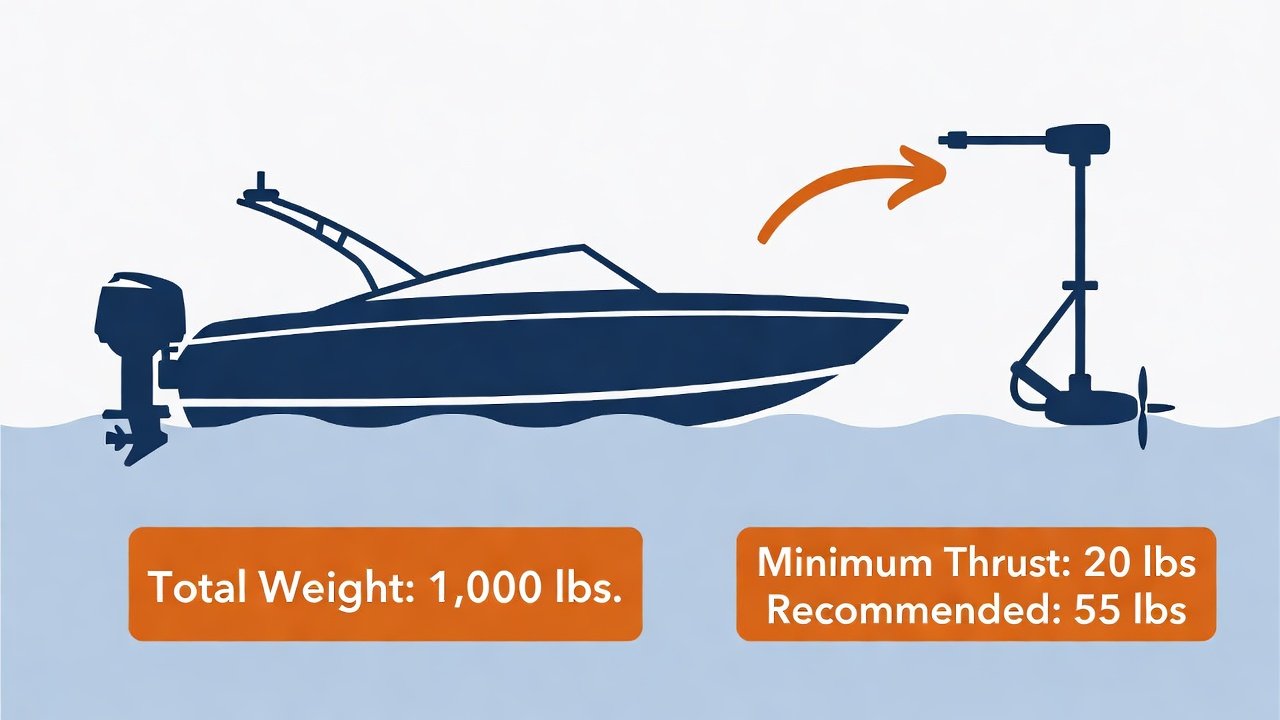
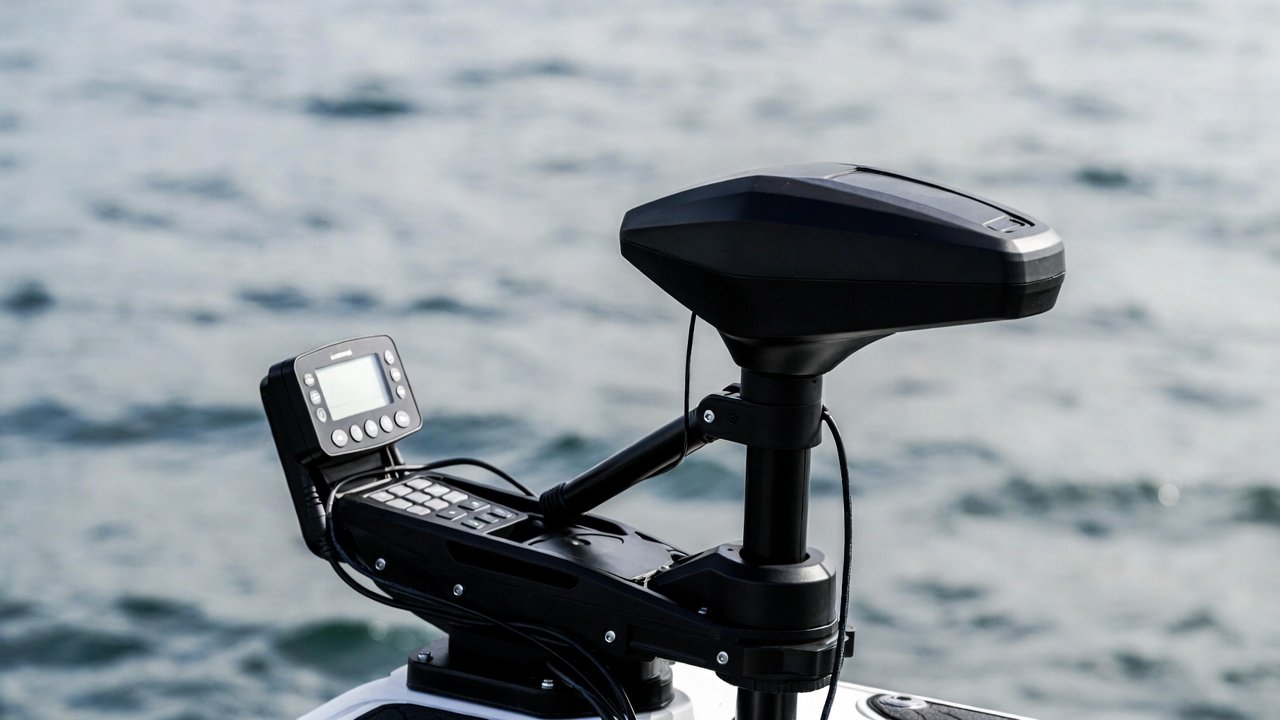
A trolling motor is a self-contained electric motor mounted on the bow or stern of a boat. It combines an electric motor, propeller, and controls in a single unit powered by one or more 12V, 24V, or 36V marine batteries. Unlike a gasoline outboard, a trolling motor operates almost silently and produces zero exhaust — two qualities that make it particularly useful for fishing in shallow or sensitive waters.
Some of the links in this article may be affiliate links. If you make a purchase through these links, we may earn a small commission at no extra cost to you. Thank you.
According to Wikipedia’s overview of trolling motors, these devices were originally designed as a secondary, low-speed propulsion source meant to help anglers move quietly around a fishing spot without disturbing fish. Modern units from brands like Minn Kota, MotorGuide, and Newport Vessels have evolved significantly, with flagship models now offering GPS-based spot-locking, wireless remote steering, and up to 112 lbs of thrust.
Trolling motors are rated by thrust (measured in pounds) rather than horsepower, though a rough conversion exists: every 100 watts of input power equals approximately 1 hp. A 55 lb thrust motor running on 12V draws around 50 amps at full power, consuming roughly 600 watts.
Can a Trolling Motor Really Be Your Only Motor?
Yes — and many anglers do exactly this, particularly on small freshwater lakes, ponds, and slow-moving rivers. The key question is whether the motor can handle your specific boat, conditions, and intended use. According to Anchor.Travel’s detailed breakdown of trolling motor primary propulsion, the answer depends heavily on boat size and weight, water conditions, and how far you plan to travel.
For very small, lightweight craft — think a 12-foot aluminum jon boat, a canoe, or a fishing kayak — a trolling motor is often perfectly adequate as the sole engine. Minn Kota, one of the most trusted names in the industry, publishes sizing guides that confirm this: a 12V 55 lb thrust motor can adequately power a jon boat up to about 1,500 lbs fully loaded.
The challenges begin when boats get heavier, distances get longer, or conditions get rougher. A mid-size bass boat, a center console, or any boat over 2,000 lbs will quickly overwhelm even the highest-thrust trolling motors. In those scenarios, the motor will work overtime, drain batteries fast, and still fail to reach useful speeds.
How Much Thrust Do You Actually Need?
Getting the thrust calculation right is critical. The widely accepted rule of thumb — cited by Bass Pro Shops, Minn Kota, and Newport Vessels alike — is a minimum of 2 lbs of thrust for every 100 lbs of total loaded boat weight. “Total loaded” means the hull, motor, batteries, gear, coolers, and all passengers combined.
| Total Boat Weight (Loaded) | Minimum Thrust | Recommended Thrust | Voltage System |
|---|---|---|---|
| Up to 500 lbs | 10 lbs | 30–40 lbs | 12V |
| 500–1,000 lbs | 20 lbs | 40–55 lbs | 12V |
| 1,000–1,500 lbs | 30 lbs | 55–70 lbs | 12V / 24V |
| 1,500–2,000 lbs | 40 lbs | 70–80 lbs | 24V |
| 2,000–3,000 lbs | 60 lbs | 80–112 lbs | 24V / 36V |
Wind and current also factor in. If you regularly fish open water where wind gusts can push your boat sideways, it’s wise to size up by at least one tier. TrollingMotors.net recommends always erring on the side of more thrust: an overpowered motor running at 50% throttle will outlast a correctly sized motor running at 90% every time.
What Types of Boats Work Best with a Trolling Motor Only?

Not all hulls are created equal when it comes to electric-only propulsion. The best candidates share a few traits: they are lightweight, have a flat or shallow-V hull that doesn’t require speed to stay stable, and are typically used on calm inland water.
Jon Boats
Jon boats are arguably the best platform for a trolling motor-only setup. Their flat-bottomed hull is naturally efficient at slow speeds, they are lightweight (a 12-foot aluminum jon boat may weigh under 200 lbs without gear), and they are stable on the calm lakes and rivers where most anglers use them. Newport Vessels specifically calls out jon boats as ideal candidates for 12V 55 lb thrust motors as primary propulsion.
Canoes and Kayaks
Canoes and fishing kayaks are so lightweight that even a 30–40 lb thrust motor provides more than enough push. The Minn Kota Endura 40 is a popular choice for canoes — its 40 lbs of thrust provides smooth, controlled movement without destabilizing the narrow hull.
Small Aluminum Fishing Boats
Small aluminum V-hulls in the 12–16 foot range, especially those used on quiet ponds or small lakes, can run quite comfortably on a 55–70 lb thrust trolling motor. These boats rarely exceed 800–1,000 lbs fully loaded, putting them well within the operational range of a good 12V or 24V setup.
How Fast and How Far Can a Trolling Motor Take You?
Speed is the biggest limitation of a trolling motor-only setup. According to Newport Vessels’ detailed performance analysis, the top end for any electric trolling motor — regardless of thrust — is around 5 mph. Most real-world scenarios deliver 2–4 mph due to hull drag, wind resistance, and load weight.
For context, a standard 25 hp outboard can push a small boat to 25–30 mph. That’s a 6–10x speed difference. If you need to cover several miles of open water to reach a fishing spot, the math quickly becomes inconvenient: at 3 mph, a 6-mile round trip takes four hours of travel time alone.
Battery runtime depends on throttle level and load. A 100Ah battery powering a 55 lb thrust motor at full throttle lasts approximately 2 hours. At 50% throttle — the more realistic fishing scenario — expect 4–5 hours. Upgrading to lithium iron phosphate (LiFePO4) batteries significantly improves usable range, as lithium batteries deliver consistent voltage throughout their discharge cycle rather than tapering off as lead-acid batteries do.
What Are the Battery Considerations for a Trolling Motor Setup?
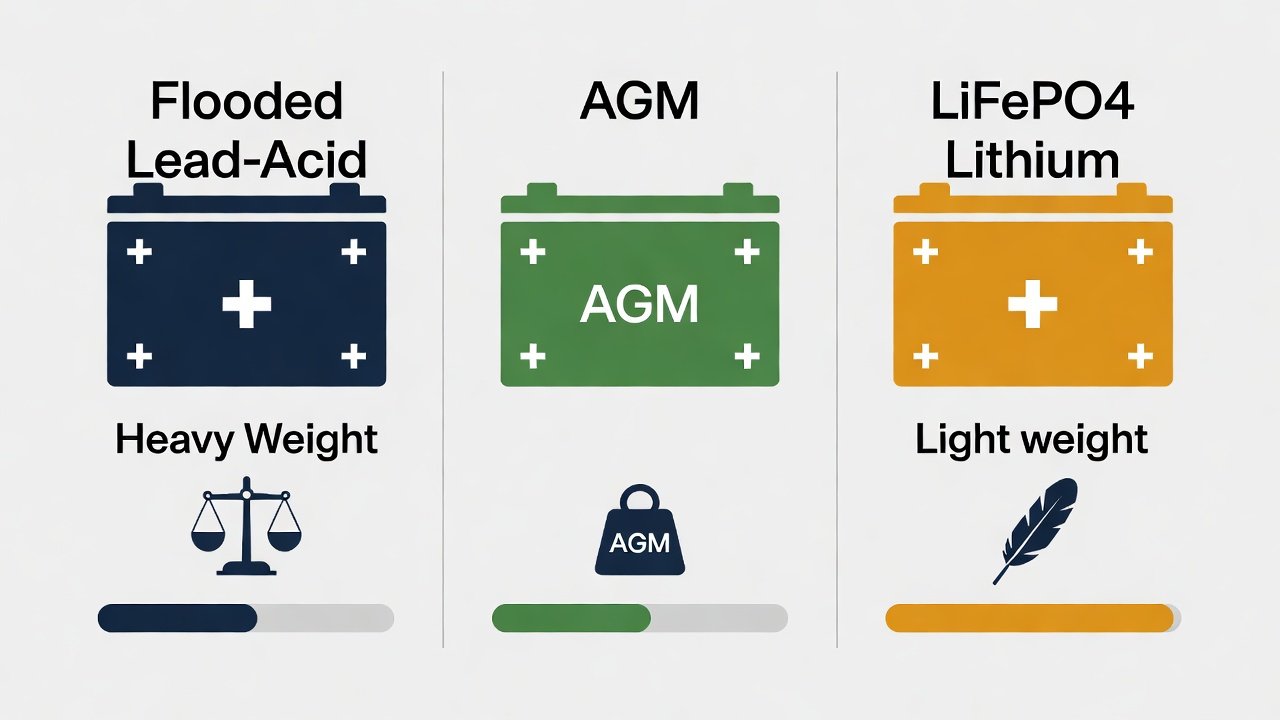
The battery is arguably the most important component of a trolling motor-only boat. Getting it wrong means getting stranded. The three main battery types are lead-acid (flooded), AGM (absorbed glass mat), and lithium iron phosphate (LiFePO4), each with distinct trade-offs.
| Battery Type | Cost | Weight | Usable Capacity | Cycle Life |
|---|---|---|---|---|
| Flooded Lead-Acid | Low ($80–$120) | Heavy (~60 lbs) | ~50% | 200–300 cycles |
| AGM | Medium ($150–$250) | Heavy (~55 lbs) | ~50–80% | 400–600 cycles |
| LiFePO4 Lithium | High ($300–$700) | Light (~25 lbs) | ~95% | 2,000–5,000 cycles |
For a trolling motor-only boat where battery life is critical, most serious anglers are migrating to LiFePO4 lithium. According to Redodo Power’s runtime guide, a 100Ah LiFePO4 battery delivers nearly twice the usable energy of a 100Ah lead-acid battery because lithium can be safely discharged to 95% depth without damage. Many customers report running full-day fishing trips — 6 to 8 hours — on a single 100Ah lithium battery.
What Are the Pros and Cons of Using Only a Trolling Motor?
Like any propulsion choice, going trolling-motor-only involves real trade-offs. Here is an honest look at both sides.
Advantages
- Near-silent operation: Electric motors produce minimal noise, letting you approach fish without spooking them — a genuine competitive advantage in clear, shallow water.
- Zero emissions: No gasoline, no exhaust, no oil. This matters on environmentally sensitive waters and increasingly in areas with emissions restrictions.
- Lower operating costs: Electricity is dramatically cheaper than gasoline. Charging a trolling motor battery costs pennies compared to filling a gas tank.
- GPS anchoring: Modern trolling motors with Spot-Lock hold your position automatically in wind and current, freeing up your hands and eliminating the need for an anchor in many scenarios.
- Lower maintenance: No engine oil changes, no spark plugs, no carburetor issues. Electric motors are fundamentally simpler than internal combustion engines.
- Simplicity and safety: No fuel spills, no fire risk, and far simpler to operate — ideal for beginners and families.
Disadvantages
- Speed ceiling: A hard cap of 3–5 mph means long distances take a long time. Not suitable for covering open water quickly.
- Range anxiety: Battery depletion mid-trip is a real risk if you don’t plan carefully. Always know your round-trip range before launching.
- Initial battery cost: A quality lithium battery setup can run $400–$800 or more upfront, though the long cycle life makes it cost-effective over time.
- Weight of batteries: Even with lithium, multiple batteries for a 24V or 36V system add significant weight that affects boat performance.
- No emergency speed: If you need to get off the water quickly due to weather, a trolling motor cannot provide the rapid transit an outboard can.
Are There Legal or Registration Requirements?
This is one of the most frequently overlooked aspects of going electric-only. Most U.S. states classify any vessel with a motor — including an electric trolling motor — as a motorized vessel, triggering registration requirements. According to ImproveSailing’s per-state registration guide, the rules vary significantly by state.
States like California, New York, and North Carolina require registration for all motor-powered boats operating on public waters, including those with only electric trolling motors. Indiana is one notable exception: boats powered exclusively by an electric trolling motor (with no other motor) are not required to be registered there.
Operator licensing also varies. Many states require a boating safety certificate for anyone operating a motorized vessel above a certain horsepower threshold. While trolling motors are typically very low horsepower (often under 1 hp), attaching one to a vessel may still trigger this requirement depending on your state’s exact language.
When Is Using Only a Trolling Motor a Bad Idea?
Honesty matters here. There are clear situations where relying on a trolling motor as your only engine is genuinely unsafe or impractical, and every boater should know them.
- Open water and ocean fishing: Tides, ocean swells, and sudden weather changes can create conditions that overwhelm a slow electric motor. Without the speed to get to shore quickly, you are dangerously exposed.
- Long-distance travel: If your fishing spot requires more than a few miles of travel, battery range and travel time make a trolling motor impractical.
- Heavy boats: Any boat over 1,500–2,000 lbs fully loaded will not move efficiently on a trolling motor, regardless of thrust rating. The motor will work at 100% continuously, draining batteries quickly and straining the unit.
- Strong current rivers: Fighting significant current eats battery life rapidly. What takes 30 minutes to travel downstream may take 2+ hours coming back, and your battery may not survive the return trip.
- Planing hulls: Bass boats, ski boats, and other hulls designed to get “on plane” require a certain minimum speed to operate efficiently. A trolling motor will never get them there, leaving them sitting low in the water and creating excessive drag.
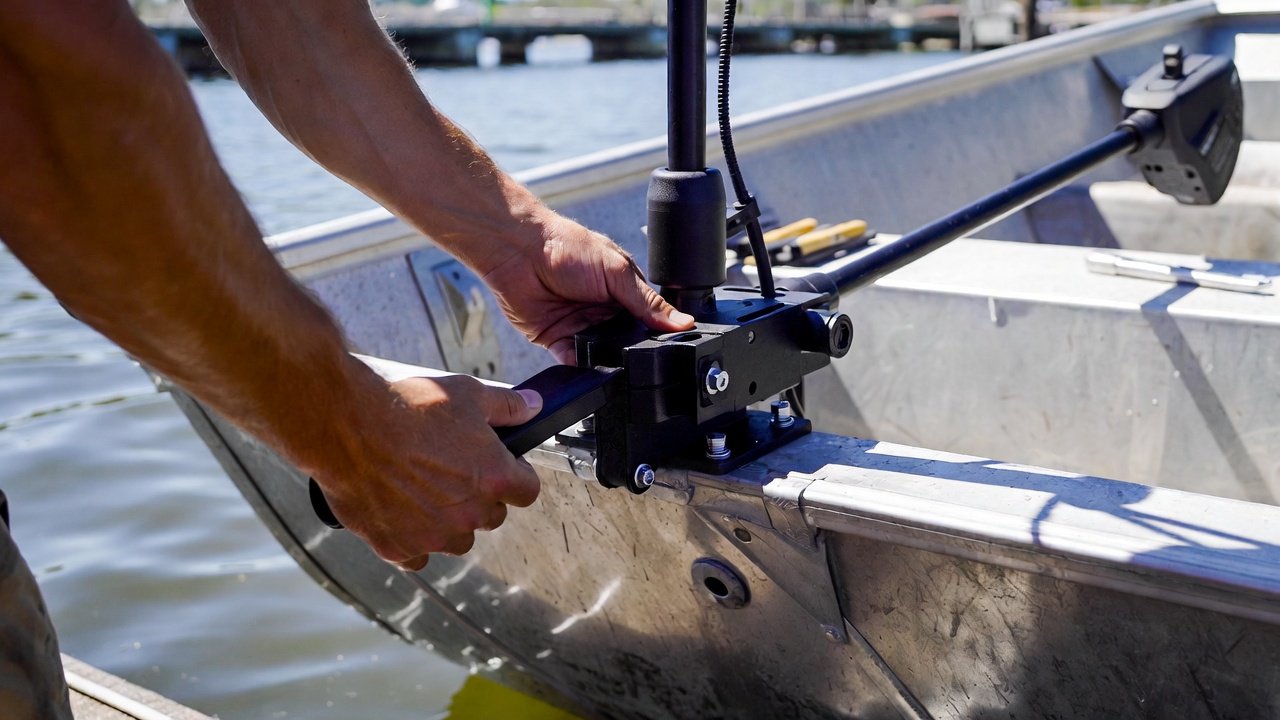
Step-by-Step Setup Guide for a Trolling Motor-Only Boat
If you have decided a trolling motor-only setup is right for you, follow these steps to get it right the first time.
Top Trolling Motor Picks for Solo Propulsion in 2026
Based on thrust ratings, reliability reviews, and suitability for primary propulsion use, these are standout performers in 2025.
Best for Jon Boats: Newport Vessels NV-Series 55 lb Thrust (12V)
Newport Vessels’ NV-Series has become a favorite budget-friendly option for jon boat owners running electric-only. At 55 lbs of thrust on a 12V system, it handles jon boats up to 1,500 lbs comfortably. Its 8-speed variable control and 5-hour battery gauge make it easy to manage range. It consistently earns praise in the fishing community for its value-to-performance ratio.

- Efficient Power: 55Lb Thrust - This 12V Electric Trolling Motor Provides Excellent Power And Efficiency For Any Boater. The High Quality Build Allows The Motor To Run All Day Long Without Overheating, Or Making Noise To Spook Fish
- 30.02lbs - The lightweight design of the Newport deep Deep cycle battery makes it easy to transport and install in your marine vessel. Enjoy powerful and reliable performance without adding unnecessary weight to your boat.
- Features: This Motor Features A 30 Inch Shaft, A 5 Led Battery Meter, A 6 Inch Telescoping Tiller Handle, And 3 Blade Propeller. The Mount Angle, Height, And Direction Can All Be Adjusted And Locked Into Place When Needed
- Sealed AGM Lead Acid - Trust in the durability and reliability of this heavy-duty marine battery. Designed with advanced technology, it provides superior power and performance, making it an ideal choice for all your boating needs. Get peace of mind with its sealed, leak-proof construction.
- Speed: This Motor Has 8 Speeds, 5 Forward And 3 Reverse. The Motor Is Designed For Trolling, So The Top Speed Of This Motor Is About 4Mph, But Depends On Your Boat Shape, Weight, Water, Wind, And Other Factors. Our 3 Blade Propeller Gives The Motor Great Low End Torque To Get The Boat Moving

Best for Small Fishing Boats: Minn Kota Endura Max 55
Minn Kota’s Endura Max line is the gold standard for budget-conscious anglers who want reliability without GPS frills. The 55 lb thrust version runs on a single 12V battery and includes a Digital Maximizer that extends battery life by up to 5x compared to non-optimized motors. It is a workhorse for flat-bottomed and small V-hull fishing boats.
No products found.
Best GPS-Enabled Option: Minn Kota Terrova 80 (24V)
For anglers who want the full modern trolling motor experience — including GPS Spot-Lock, i-Pilot remote control, and autopilot — the Terrova 80 is the benchmark. It delivers 80 lbs of thrust on a 24V system, making it suitable as the sole motor on boats up to approximately 2,000 lbs. The Spot-Lock feature alone is worth the investment for serious anglers who fish in wind.
No products found.
Best Budget Option for Canoes and Kayaks: Watersnake T18
For canoes, kayaks, and very small tenders, the Watersnake T18 offers 18 lbs of thrust on a 12V system in a compact, lightweight package. At this size, it provides gentle propulsion without overwhelming narrow hulls. It is frequently cited in canoe fishing forums as a reliable low-cost entry point for electric propulsion.
Frequently Asked Questions
Can a trolling motor replace an outboard motor entirely?
On small, lightweight boats used on calm inland waters, yes. A trolling motor can serve as the only engine on jon boats, canoes, and small aluminum fishing boats under 1,500 lbs. On larger or heavier boats, or those used on open water, it cannot realistically replace an outboard because of speed and range limitations.
How fast will a trolling motor go?
The top speed of any electric trolling motor — regardless of thrust — is approximately 3–5 mph. Most real-world fishing scenarios see 2–4 mph due to boat weight, wind, and current. This compares to 25–40+ mph for a comparable gasoline outboard.
How long will a trolling motor battery last on one charge?
A 100Ah battery powering a 55 lb thrust motor at full throttle lasts roughly 2 hours. At a more realistic 50% throttle, expect 4–6 hours. Lithium (LiFePO4) batteries offer nearly double the usable capacity of equivalent lead-acid batteries and are the preferred choice for all-day fishing trips.
Do I need to register a boat that only has a trolling motor?
In most U.S. states, yes. States including California, New York, and North Carolina require registration for any motorized vessel operating on public waters, including those powered only by an electric trolling motor. A few states like Indiana provide exemptions for electric-only vessels. Always verify with your state’s boating authority before launching.
What is the best trolling motor for a jon boat used as the only motor?
For most jon boats under 1,500 lbs, a 12V 55 lb thrust motor — such as the Newport Vessels NV-Series 55 or Minn Kota Endura Max 55 — provides adequate propulsion. For jon boats approaching 1,500–2,000 lbs, step up to a 24V 70–80 lb thrust unit for better performance and motor longevity.
Is a trolling motor-only boat safe?
On calm, inland waters — ponds, small lakes, and sheltered rivers — a trolling motor-only boat is entirely safe when properly sized and maintained. The risk increases on open water, in strong current, or in unpredictable weather, where the lack of emergency speed becomes a genuine safety concern. Always carry a paddle as a backup and file a float plan before launching.
Can I use a trolling motor in saltwater?
Yes, but you need a motor specifically rated for saltwater use — these have corrosion-resistant coatings and sealed components. Standard freshwater trolling motors will corrode quickly in salt. Brands like Newport Vessels and Minn Kota offer dedicated saltwater models. Rinse the motor thoroughly with fresh water after every saltwater use.
Conclusion: Should You Go Trolling Motor-Only?
A trolling motor as your only motor is a genuine, practical choice — provided your situation matches what the technology actually delivers. If you fish calm ponds, small lakes, or sheltered backwaters from a lightweight jon boat, canoe, or kayak, going electric-only is one of the smartest decisions you can make. You will save money on fuel, fish more quietly, and enjoy the simplicity of electric power.
The 2025 market has also never offered better options. GPS-enabled motors with Spot-Lock, longer-lasting LiFePO4 batteries, and more reliable motor electronics make electric-only setups more capable than ever. If your situation fits the profile — small boat, calm water, short-to-medium range — a trolling motor-only setup deserves serious consideration.
If you need speed, range, or open-water capability, pair your trolling motor with a gasoline outboard. But don’t let perfect be the enemy of good: for the right angler in the right environment, there’s nothing better than the quiet hum of an electric motor on a still morning.