Getting your trolling motor setup right comes down to three things: choosing a motor that fits how you fish, sizing shaft and thrust to your boat, and knowing how to track down problems before they ruin a trip. Nail all three and you will spend far more time fishing than fixing.
Quick Answers: Trolling Motor Setup at a Glance
- Thrust rule of thumb: A widely cited starting point is roughly 2 lbs of thrust for every 100 lbs of total boat weight, fine-tuned from there based on hull design and conditions.
- Shaft length balance: Long enough to keep the prop submerged in choppy water; short enough to leave workable deck space when stowed.
- Most “motor problems” aren’t motor problems: Battery condition, corroded connections, and failed circuit breakers are the most frequent culprits.
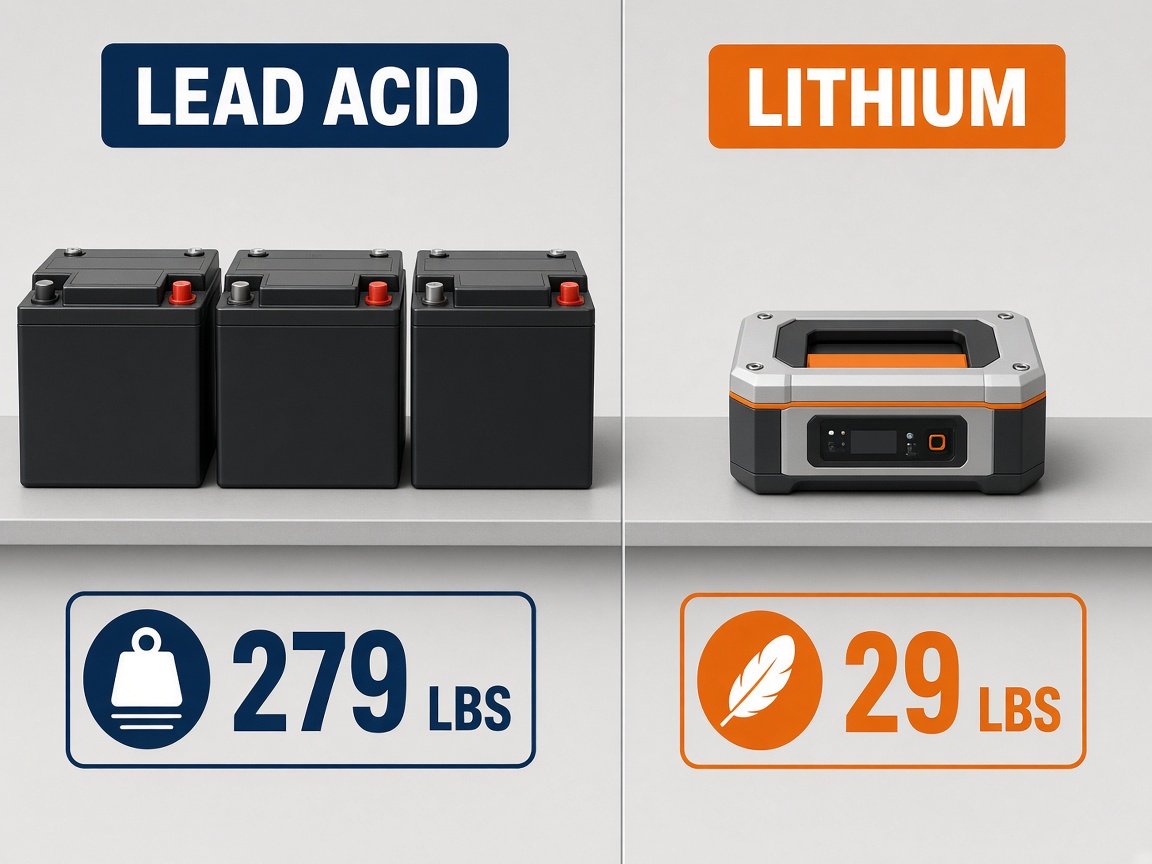
- Battery upgrade considerations: Lithium packs save significant weight and space over lead acid but require lithium-compatible chargers and carry a higher upfront cost.
What Makes a Trolling Motor the Right Fit for Your Fishing Style?
Before you look at a single spec sheet, it is worth asking how you actually use a trolling motor on the water. Offshore anglers who need to hold position against wind and tide have completely different demands than someone easing along a shallow grass flat, or a bottom fisherman who mainly wants a reliable spot-lock. The motor that is perfect for one application can be frustrating, inefficient, or even impractical for another.
Some of the links in this article may be affiliate links. If you make a purchase through these links, we may earn a small commission at no extra cost to you. Thank you.
Bluewater Marine Service technicians William Montgomery and Chad Eubanks emphasized this point in a September 2025 interview with Great Days Outdoors. “We always start by asking what their expectations are,” Montgomery said. “Are they offshore fishing? Are they inshore fishing? Are they trying to actually maneuver the boat, or are they just trying to do a spot lock?” That framing shapes every decision that follows — from thrust rating and shaft length to the type of control system that makes the most sense for how you fish. Getting clear on your use case first prevents you from buying too much motor, or not nearly enough.
How Long Should Your Trolling Motor Shaft Be?
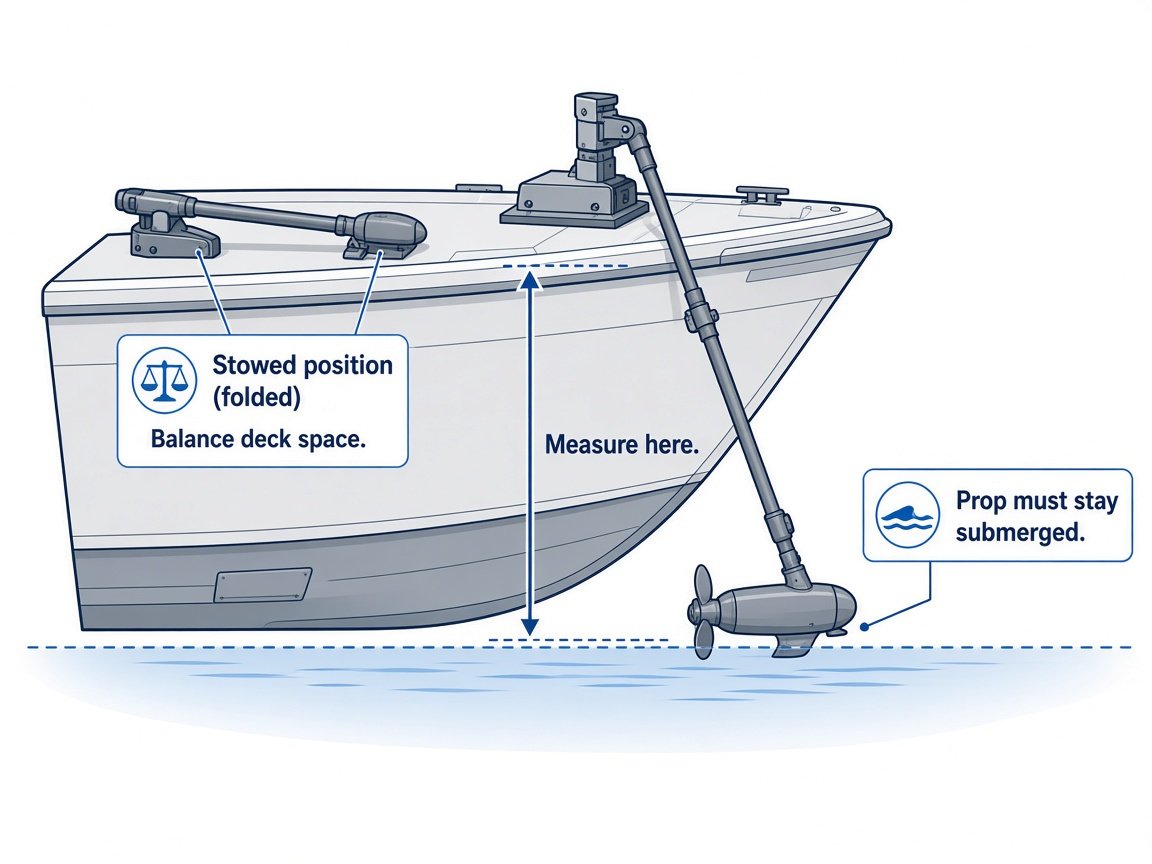
Shaft length is one of the specs anglers most often get wrong, usually by going too long under the assumption that longer is always safer. The real goal is finding the length that keeps the propeller assembly fully submerged across your typical sea conditions while still allowing you to stow the motor without it consuming the entire bow deck.
Montgomery explained the submersion side of the equation in the same Great Days Outdoors interview: “The critical thing is you have to have that motor and propeller assembly deep enough in the water so where it doesn’t cavitate. But then on top of that, when you start getting into seas — one foot, two foot seas — the boats rock and roll, and you have to have plenty of shaft to keep that trolling motor deep in the water to ensure it’s going to operate properly.” Chad Eubanks added the often-overlooked flip side: “You have to stow that trolling motor at some point, and so you have to find that balance of usable deck space that you can forfeit to a trolling motor.”
The standard method is to measure from your mounting surface down to the waterline, then apply the specific manufacturer’s sizing chart for your brand — each one calculates the final shaft recommendation slightly differently. If you want a detailed walkthrough for your hull type, the complete trolling motor sizing guide for every boat type takes you through the entire process step by step.
How Much Thrust Does Your Boat Actually Need?
Thrust ratings can be confusing because there is no single formula that works perfectly for every boat in every condition. The most widely referenced rule of thumb — cited by William Montgomery in his September 2025 interview with Great Days Outdoors — is roughly 2 lbs of thrust for every 100 lbs of total boat weight, including gear and passengers. From that number, you adjust upward for factors like a high bow, frequent offshore use in wind and current, or consistently strong tidal flow.
It is also worth remembering that more thrust draws more current from your battery. Running a motor that is significantly oversized for your actual needs means you are burning through battery capacity faster than necessary. The goal is matching thrust to your realistic on-water demands — not simply buying the most powerful motor in the lineup. Keeping that balance tight pays dividends in runtime over a full fishing day.
Bow-Mount vs. Transom-Mount: Which Setup Suits You?
Mounting position is a fundamental choice that affects both performance and boat compatibility. Bow-mount motors attach at the front of the boat and pull it through the water, giving you far more precise directional control — particularly useful when you are working a specific piece of structure or holding position with a GPS anchor-lock feature. Most serious bass, walleye, and inshore anglers opt for bow-mount designs for exactly this reason, and virtually all high-end spot-lock systems are built into bow-mount platforms.
Transom-mount motors attach at the rear of the boat and push it forward. They are typically lighter, easier to install, and more affordable, which makes them an excellent choice for smaller vessels like jon boats, canoes, and aluminum fishing boats where bow-mount hardware is not practical. If you fish from a compact setup and want flexibility, the deep dive on transom-mount trolling motors for small boats covers what to look for and which configurations work best in different scenarios.
Lithium vs. Lead Acid: Which Battery Powers Your Trolling Motor Best?
Battery choice has a bigger impact on day-to-day trolling motor performance than most anglers initially realize. Lead acid batteries — both flooded and AGM — have been the standard for decades and remain a cost-effective option, particularly if you replace your boat on a regular cycle. They work reliably with most standard chargers and are widely available. The trade-off is weight, bulk, and a gradual voltage drop throughout the discharge cycle that can reduce motor performance as the day progresses.
Lithium batteries change that picture substantially. Montgomery described the difference in the Great Days Outdoors interview: “With lithium, you can get a battery that’s not much bigger than a single group 31, but it’s 36 volts and has more capacity than three lead acids combined. It’s a huge space saver and lighter, too.” Eubanks offered an important caveat: “Sometimes you have to change the charger or buy a lithium-specific charger. It’s not always a straightforward, ‘Oh yeah, let’s just do lithium.'” The case for upgrading strengthens considerably if you fish all day regularly, guide professionally, or plan to keep your boat for ten to fifteen years or more. For a comparison of the best-performing options, the guide to deep cycle marine batteries for trolling motors breaks down what matters most in each category.
What Are the Most Common Trolling Motor Problems — and How Do You Fix Them?
When something goes wrong with a trolling motor, the instinct is to assume the motor itself is at fault. In practice, that is often not the case. Montgomery put it plainly in the Great Days Outdoors interview: “The failure that’s causing the problem is actually not a trolling motor problem. A lot of times it’s something going on with the batteries, or corrosion, or a bad circuit breaker.” Before you schedule a service call or start pricing replacement motors, work through the most common non-motor culprits first.
One frequently overlooked component is the stow sensor. As Eubanks explained: “It senses when the trolling motor is stowed so you can’t accidentally turn the propeller on. We see a lot of those fail.” Other quick-to-miss issues include dead batteries in the wireless remote, loose wiring at the battery terminals, corroded connections at the breaker or bow, and a lost pairing between the motor and its GPS unit or remote. If your foot pedal is behaving unexpectedly, the step-by-step walkthrough for diagnosing a trolling motor foot pedal that has stopped working is a useful place to start before assuming a larger mechanical failure.
- Dead remote batteries — Replace before every season and carry spares on the boat.
- Loose or corroded connections — Check terminals at the battery, circuit breaker, and bow mount point.
- Bad circuit breaker — A blown or failing breaker can mimic a completely dead motor.
- Failed stow sensor — Prevents the motor from activating even when fully deployed and locked in position.
- Lost GPS or remote pairing — Re-pair per the manufacturer’s instructions before assuming any hardware fault.
Does It Matter Whether You Fish in Salt or Fresh Water?
It matters quite a bit. Saltwater is significantly more corrosive than freshwater, and a motor that is not rated for marine use will degrade rapidly when exposed to salt, spray, and humid sea air on a consistent basis. Saltwater-specific trolling motors use sealed components, corrosion-resistant hardware and coatings, and protective treatments that standard freshwater motors simply do not have. Using a freshwater motor in a saltwater environment will typically void the warranty and shorten the motor’s lifespan considerably.
If you fish both environments — which many coastal anglers do — it is worth understanding exactly where the design differences lie and what precautions matter. The in-depth comparison of saltwater vs freshwater trolling motors covers the construction differences, the consequences of crossing environments, and how to choose a setup that holds up in both without sacrificing durability on either end.
Should You Consider a Brushless Trolling Motor?
Motor technology has shifted meaningfully in recent years. Traditional brushed motors have served anglers well for decades and remain perfectly capable for most applications. Brushless motors eliminate the physical brush-and-commutator contact that causes wear in brushed designs. Based on manufacturer specifications and owner reports, the result is greater energy efficiency, reduced heat generation under sustained use, and longer service life — particularly relevant for anglers running motors hard across long fishing days.
Brushless designs are also reported by owners to maintain more consistent thrust across the battery’s discharge range compared to brushed motors under heavy loads. That said, brushless motors generally carry a higher price tag. Whether the efficiency gain justifies the premium depends on how often you are on the water and what your total battery and motor budget looks like. For a side-by-side breakdown, Trolling Motor King’s comparison of brushless vs brushed trolling motors goes through the efficiency data in real-world terms.
What Should You Check Before Every Trip?
A five-minute check before you leave the dock can prevent a full day from being derailed by an entirely avoidable problem. Bluewater Marine Service’s William Montgomery recommends a straightforward pre-trip routine covering the components most likely to cause trouble on the water, as outlined in the September 2025 Great Days Outdoors interview.
- Check the batteries — Look for visible corrosion on terminals and confirm all wiring connections are secure.
- Test the charger — Especially after any extended period of non-use; verify it is outputting correctly before you rely on it.
- Inspect all connections — At the battery, the circuit breaker, and the bow mount point where the motor attaches.
- Check the remote batteries — Replace or test before you get on the water, not after the motor fails to respond.
- Deploy the motor dockside — Confirm it runs, the GPS pairs correctly, and it responds fully to all control inputs before you leave the ramp.
“Charge the batteries, make sure everything’s topped up before your trip,” Montgomery said. “Clean the connections and check them all.” This habit applies equally to weekend anglers and professional guides — catching a corroded terminal or a dead remote battery in the driveway takes two minutes and costs nothing compared to diagnosing the same problem mid-drift.
How Should You Charge and Store Your Trolling Motor Batteries?
Charging habits have a surprisingly large effect on how long your batteries last and how well they perform across a season. For lead acid batteries, Montgomery’s guidance from the Great Days Outdoors interview is reassuring for anyone who likes the convenience of leaving things plugged in: “For lead acid, if you have a modern three-stage charger that goes into float mode, leave them plugged in. It’s totally safe.” A three-stage charger cycles automatically through bulk charge, absorption, and float maintenance, so there is no risk of overcharge damage with a quality modern unit.
Lithium is a more nuanced conversation. As Montgomery explained: “Some lithiums allow for constant float charging, and some don’t. You really need to go by what the battery manufacturer recommends.” The key word is your battery’s documentation — not generic lithium advice from online forums, which often conflates different lithium chemistries. Storing any battery chemistry at a very low state of charge for extended periods accelerates cell degradation, so a full charge before long-term storage is good practice across the board.
What Is Coming Next in Trolling Motor Technology?
Several trends are reshaping what anglers can expect from trolling motors over the next twelve to twenty-four months. Brushless motor designs are moving from premium-tier products into the mid-range, making energy-efficient propulsion more accessible across a broader range of price points. GPS spot-lock and auto-pilot features that were once exclusive to flagship models are appearing further down the product ladder as the underlying electronics mature and cost curves continue to fall.
Battery technology is evolving in parallel. Lithium drop-in replacements designed to work with existing standard chargers are becoming more common, addressing one of the main friction points that has historically slowed lithium adoption for many anglers. App-based motor control — where a smartphone becomes a secondary or primary remote — is also expanding across more brands and price tiers. Anglers buying a motor today are well served by thinking about platform compatibility: how the motor will integrate with the battery systems and control interfaces they are likely to upgrade to over the next few years matters as much as the motor’s performance figures today.
Frequently Asked Questions About Trolling Motors
How much thrust does a trolling motor need?
A commonly used starting point, cited by marine service professionals, is 2 lbs of thrust for every 100 lbs of total boat weight including gear and passengers. Adjust upward for high bow profiles, offshore conditions, or strong currents. Under-sizing is the more common mistake — a motor running at full throttle constantly will drain your battery faster and wear out sooner than one with appropriate headroom.
What shaft length should I choose for my trolling motor?
Measure from your mounting surface to the waterline, then apply the specific manufacturer’s sizing chart for your brand — each one calculates its recommendations slightly differently. The shaft needs to keep the prop submerged across your typical wave conditions while still leaving workable deck space for stowing. When choosing between two adjacent sizes, the longer option is generally the safer call for anyone fishing in variable or rough conditions.
Can I use a freshwater trolling motor in salt water?
It is not recommended. Freshwater motors are not sealed or coated to handle saltwater corrosion, and regular exposure shortens their lifespan considerably. Most manufacturers void the warranty on freshwater motors used in marine environments. If you fish both, look for a motor explicitly rated for saltwater use from the outset.
Why is my trolling motor running but barely moving the boat?
The most likely causes are low battery voltage under load (even a battery that reads fine at rest can sag under full draw), a fouled prop with weeds or fishing line wrapped around it, or a motor that is under-sized for the loaded boat weight. Check the battery’s voltage under actual load and inspect the prop for obstructions before assuming the motor itself is at fault.
Can I leave my trolling motor batteries on the charger?
For lead acid batteries with a modern three-stage charger that enters float mode, yes — it is safe to leave them connected. For lithium batteries, the answer depends on your specific battery’s design; some support continuous float charging and some do not. Always follow your battery manufacturer’s documentation rather than general lithium-battery advice, which often conflates different chemistries.
What is a stow sensor, and why does it matter for troubleshooting?
A stow sensor detects when the motor is in its raised, stowed position and prevents the propeller from activating accidentally. As Bluewater Marine Service’s Chad Eubanks noted in a September 2025 interview with Great Days Outdoors, stow sensor failures are common and are frequently mistaken for motor failures. If your motor will not activate when fully deployed, the stow sensor is worth checking early in your diagnosis process.
Is it worth upgrading to a lithium battery for a trolling motor?
Lithium batteries offer real advantages in weight, space, and consistent power delivery — but the upfront cost is significantly higher than lead acid. The case for upgrading is strongest if you fish full days regularly, guide professionally, or plan to keep your boat for a decade or more. If you replace your boat every few years or fish only occasionally, lead acid may still be the more cost-effective choice for your situation.
What is the difference between a 12V, 24V, and 36V trolling motor system?
The voltage rating refers to the battery system the motor requires. A 12V system uses one 12-volt battery, a 24V system uses two wired in series, and a 36V system uses three. Higher voltage systems generally deliver more thrust and run more efficiently at high power outputs — but they also require more batteries and more charging hardware. The right voltage tier for your boat depends on your thrust requirement and how much battery space you have available.
Ready to Hit the Water? Your Next Steps
Trolling motor setup does not need to be complicated. Work through it in the right order: start with how you fish, then match shaft length and thrust to your hull, then choose a battery system that fits your time on the water. Build a quick pre-trip habit, and you will catch problems in the driveway rather than on the drift.
Here is a simple sequence to get from zero to fully dialed-in:
- Define your fishing style — Offshore holding, inshore maneuvering, structure fishing, or spot-lock? This determines control type, thrust needs, and mount position.
- Measure your boat — Waterline-to-mount distance for shaft length, fully loaded weight for your thrust baseline.
- Choose your battery system — Lead acid for lower upfront cost; lithium for long-term performance and weight savings. Confirm charger compatibility before purchasing.
- Run a bench test before the first trip — Deploy the motor, pair the GPS and remote, run through all speed settings, then stow and re-deploy to confirm the stow sensor is functioning.
- Build a pre-trip checklist habit — Five minutes of checks before every outing prevents the most common on-water failures, and it costs nothing.
The team at Trolling Motor King covers motor types, battery options, and use-case-specific recommendations across a wide range of fishing scenarios. Whether you are rigging a bay boat for inshore casting or setting up a center console for offshore spot-locking, the right setup is achievable — it just takes a few well-informed decisions to get there.