If you’re researching the Minn Kota Fortrex trolling motor, this review cuts through the spec sheet to tell you what this bow-mount actually delivers. With Digital Maximizer efficiency technology, a weed-shedding Power-Prop, and Minn Kota’s impact-resistant composite shaft, it’s a compelling package — provided you understand what it is, and what it isn’t.
Our verdict — 4.4 / 5
Some of the links in this article may be affiliate links. If you make a purchase through these links, we may earn a small commission at no extra cost to you. Thank you.
The Minn Kota Fortrex is a premium cable-steer bow-mount that delivers strong battery efficiency and genuine durability for serious freshwater fishing. It’s the right call for experienced anglers who prefer direct foot-pedal control and fish big water hard — but anglers who want GPS-based Spot-Lock anchor should budget up to the Terrova instead.
Who the Minn Kota Fortrex Trolling Motor Is Built For
The Fortrex is designed for anglers running medium to large boats — typically in the 18-to-22-foot range — on lakes, rivers, and reservoirs where conditions can turn challenging. If you fish big water, spend long days on the bow, and care deeply about how long your batteries last through a tough afternoon of headwind and current, the Fortrex’s core spec sheet addresses those concerns directly. Multiple thrust configurations mean you can size the motor to a heavier hull without compromising holding power.
If you’re fishing a kayak, canoe, or small jon boat, the Fortrex is overbuilt and overpriced for the application — lighter, simpler motors are the better fit. Anglers who want GPS-based anchoring, hands-free positioning, or a wireless remote as standard equipment should also look elsewhere. The Fortrex is a cable-steer motor only, and that is a hard line in its design philosophy.
How We Researched This Review
This review is based on the manufacturer’s published specifications, product listing information, and aggregated verified purchase reviews from owners across multiple Fortrex configurations. No hands-on testing was conducted. Performance descriptions throughout this article reflect what the motor’s design and specifications are intended to deliver and what verified owners consistently report — not first-hand observation. This review was prepared by the Trolling Motor King editorial team.
Design, Build Quality, and First Impressions
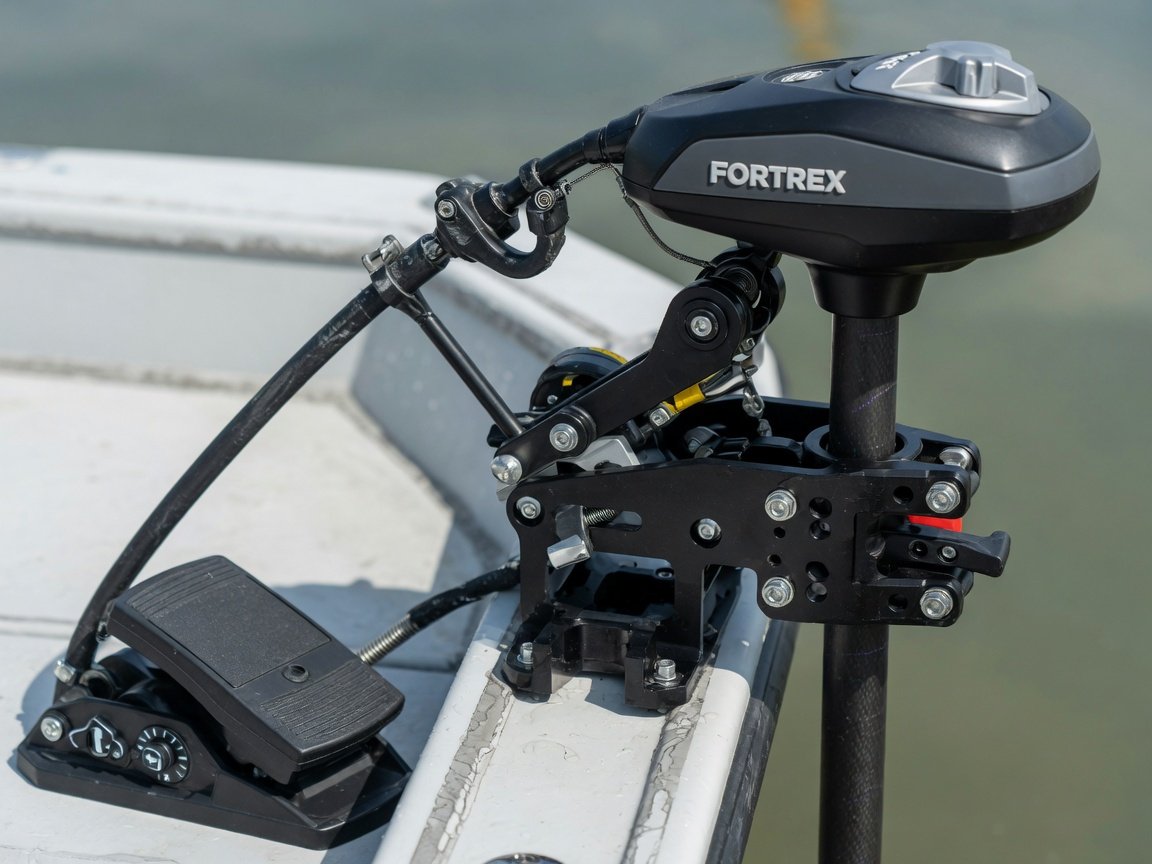
The Fortrex is built to a premium standard by Minn Kota’s own benchmarks. The composite shaft — which Minn Kota markets as indestructible — is designed to flex under impact from submerged stumps and rocks rather than snap or permanently deform. Owners who fish rocky river systems and timber-heavy reservoirs frequently cite this shaft design as one of the primary reasons they chose the Fortrex over competitors using aluminum shafts, which can bend or dent when they strike something solid at speed.
The Lift-Assist lever uses a counterbalanced spring mechanism to offset the weight of the motor head when raising it from the water. On higher-thrust models, the motor assembly is heavy, and this feature receives consistent positive mentions from verified owners. The ergonomics of deploying and stowing a trolling motor at the end of a long day on the water matter more in practice than they may seem in a showroom.
Steering is handled through a cable-connected foot pedal — a design Minn Kota has refined across many product generations. Digital variable speed control, delivered through the Digital Maximizer system, manages power delivery electronically rather than through fixed resistance settings the way older analog designs do. What comes in the box: the motor and mount assembly, the foot pedal with attached cable, and the hardware for installation. Battery, charger, and electronic accessories are sold separately.
Verified purchase reviews describe overall build quality as solid, with the mount bracket and motor housing drawing consistent praise for their feel and finish. A recurring concern in a minority of owner reviews involves the foot pedal cable connection showing wear over several seasons of heavy use — something to monitor on older units and worth factoring into long-term maintenance planning.
Real-World Performance: What Owners Report
Thrust, Sizing, and Holding Power
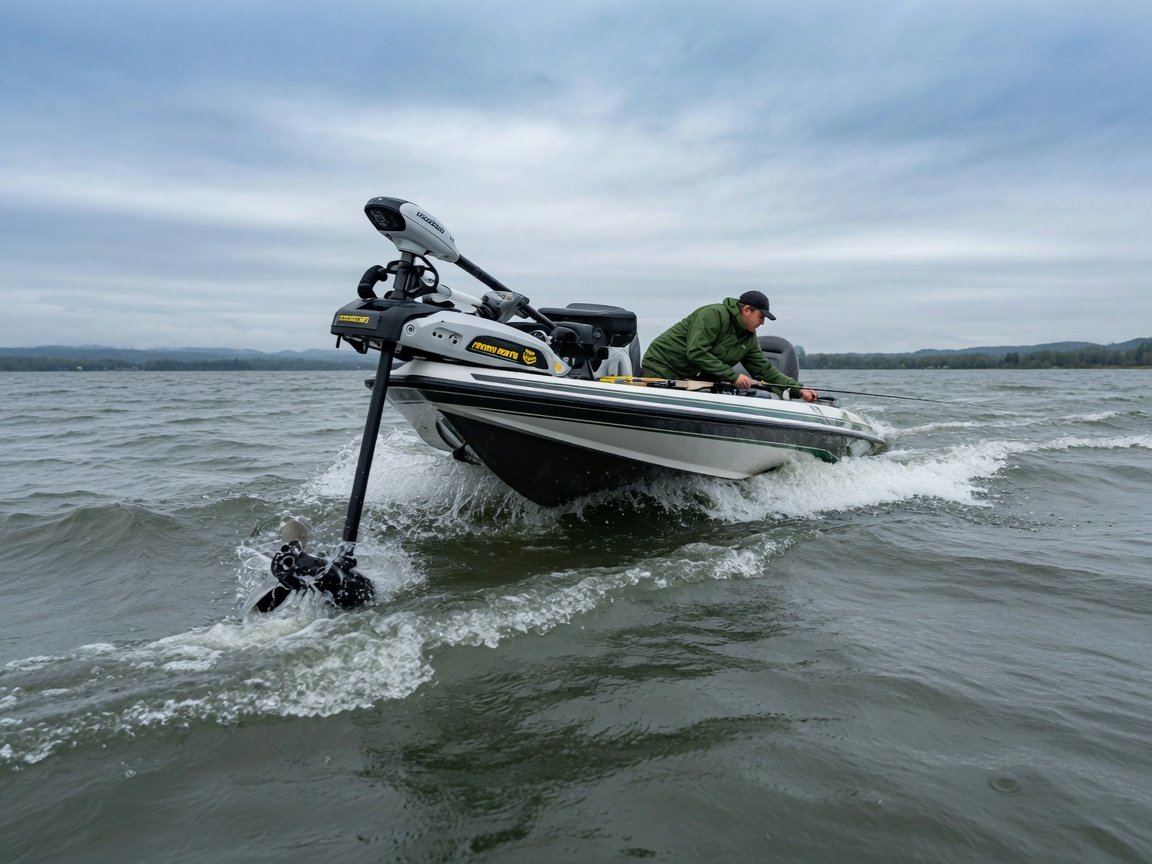
The Fortrex is available in multiple thrust configurations suited to different boat sizes and fishing conditions. Per Minn Kota’s published sizing guidelines, the recommended starting point is approximately 2 lbs of thrust per 100 lbs of loaded boat weight — though most experienced anglers size up to account for wind and current rather than calculating purely for flat-calm conditions. The demands of big-water fishing — sustained headwinds, boat wakes, and river current — are where higher-thrust Fortrex configurations separate themselves from lighter options. Owners fishing large impoundments and open lake systems consistently describe the motor holding position in conditions that overwhelm lower-thrust motors.
Battery Efficiency and the Digital Maximizer
Digital Maximizer is Minn Kota’s core efficiency argument for the Fortrex. Traditional analog speed controls bleed excess energy as heat by restricting current through fixed resistance points. The Fortrex’s digital system adjusts power delivery continuously to match the actual load on the motor at any given moment. The practical effect, per verified purchase reviews, is meaningful: owners stepping up from older analog motors to the Fortrex routinely report noticeable improvements in how far through the day their batteries carry them before performance drops. Battery selection matters just as much as motor efficiency — a well-sized, quality battery fully realizes what Digital Maximizer delivers. The guide to the best batteries for Minn Kota trolling motors covers which options match each thrust and voltage configuration for a full day on the water.
Weed Performance and the Power-Prop
The Power-Prop is Minn Kota’s weed-resistant propeller design, and it performs meaningfully in vegetation-heavy lake systems. The blade geometry is engineered to shed aquatic growth rather than wrap it around the hub — a persistent frustration with standard trolling motor props in heavy milfoil, hydrilla, or lily pad fields. Owners fishing weedy systems specifically cite the Power-Prop as a genuine differentiator: fewer stops to clear the prop, more continuous fishing time. It isn’t immune to the absolute heaviest vegetation, but the improvement over a standard propeller design is real and widely reported across verified reviews.
Fish Finder Integration with Universal Sonar 2
Universal Sonar 2 (US2) is a built-in cable channel that routes your sonar transducer cable internally through the motor shaft, from the head down to the transducer, eliminating any external cable running along the shaft or dangling loose at the bow. This keeps the deck clean and ensures the transducer sits at the correct depth automatically when the motor deploys. US2 compatibility is designed primarily around Humminbird units. The full Minn Kota fish finder mount compatibility guide details which units connect natively and which require an adapter — worth checking before assuming your sonar will plug right in without additional hardware.
Foot Pedal Steering and Day-to-Day Usability
The cable-steer foot pedal delivers direct, proportional feedback that experienced bow-mount anglers tend to prefer for precision work around shallow cover and structure. There is no processing lag — the motor responds in proportion to pedal input, and the variable speed sweep moves smoothly from slow trolling speeds to full power. The pedal holds its position without creeping under foot. The real limitations of cable steer are honest ones: the cable can stiffen in cold temperatures, which affects pedal feel on early-season and late-season trips. And the Fortrex has no autopilot or GPS anchor mode whatsoever — an angler on the pedal is required whenever positioning matters. For anyone who wants to step away from the pedal and hold a specific GPS waypoint, this motor is not the right platform.
Pros and Cons
What We Liked
- Digital Maximizer delivers measurably better battery runtime than analog-controlled motors, per consistent verified owner reports across multiple configurations
- Power-Prop weed-shedding blade geometry noticeably reduces prop-clearing stops in heavy milfoil, hydrilla, and lily pad environments
- Composite shaft handles impacts from submerged stumps and rocks without permanent damage — a meaningful durability edge over aluminum-shaft alternatives
- Lift-Assist lever makes raising and lowering the motor significantly easier, especially on heavier high-thrust models where the assembly has real mass
- Universal Sonar 2 internal cable routing produces a clean bow installation with no external transducer cable cluttering the shaft
- Direct cable-steer foot pedal is preferred by many experienced anglers for close-quarters fishing in heavy cover where instant responsiveness matters
What Could Be Better
- No GPS anchor (Spot-Lock) or i-Pilot integration of any kind — this is a cable-steer motor only, and that’s a firm design boundary, not a minor omission
- Foot pedal cable stiffens noticeably in cold temperatures, affecting steering feel on early- and late-season outings
- Higher-thrust models are heavy and bulky to mount — a second pair of hands is genuinely useful for the initial installation
- Premium price relative to basic bow-mounts is harder to justify for anglers who fish infrequently or on small, sheltered bodies of water
Who Should Consider an Alternative
The Fortrex’s single biggest limitation is one it shares with every other cable-steer motor: there is no GPS anchoring. If Spot-Lock or any hands-free position-holding feature is part of your fishing style — hovering over a sonar waypoint, holding a specific current seam without constant pedal input — the Fortrex will frustrate you regardless of its other strengths. Minn Kota’s own Terrova adds i-Pilot GPS to most of the Fortrex’s core features at a higher price, and that is the most direct upgrade path within the brand. For a broader view across brands and price points, the guide to the best trolling motors with Spot-Lock covers the full current field. Anglers who specifically fish in difficult open-water conditions may also find the roundup of trolling motors built for windy conditions worth comparing against the Fortrex’s thrust ratings before deciding.
Pricing and Where to Buy
The Minn Kota Fortrex is available in several configurations — thrust rating and shaft length are the primary variables, and higher-thrust, longer-shaft models carry meaningfully higher price tags than the entry-level configuration. Pricing shifts with seasonal promotions and inventory levels, so checking current listings close to your purchase date is worthwhile. Total cost of ownership extends well beyond the motor itself: the appropriate battery system — a single 12V battery for 70 lb models, two 12V batteries wired in series for 24V configurations, or three for 36V setups — is a significant additional line item. The full trolling motor battery cost-of-ownership breakdown works through the real numbers on what battery systems cost over time, including replacement cycles that most buyers don’t factor in upfront.
Disclosure: Trolling Motor King may earn a commission from qualifying purchases made through affiliate links on this site.
Frequently Asked Questions
What is the difference between the Minn Kota Fortrex and the Minn Kota Terrova?
The core difference is GPS functionality. The Fortrex is a cable-steer motor with no GPS, no i-Pilot system, and no Spot-Lock — you steer manually with the foot pedal at all times. The Terrova adds Minn Kota’s i-Pilot GPS system, which includes Spot-Lock GPS anchor, cruise control, and in many configurations a wireless remote, all at a higher price. If hands-free precise positioning matters to how you fish, the Terrova is the correct choice. If you prefer direct foot-pedal control and want strong efficiency without paying for GPS features you won’t use, the Fortrex makes the stronger financial case.
Does the Minn Kota Fortrex have Spot-Lock?
No. The Fortrex does not include Spot-Lock or any GPS anchor feature. It is a cable-steer motor only — Spot-Lock is an i-Pilot GPS feature exclusive to Minn Kota’s Terrova and Ulterra models. If GPS anchoring is a must-have for your fishing style, the Fortrex is not the right motor regardless of its other merits. The Terrova is Minn Kota’s most direct path to pairing i-Pilot capability with an otherwise similar feature set.
What thrust rating do I need for the Minn Kota Fortrex?
Per Minn Kota’s published sizing guidelines, the rule of thumb is approximately 2 lbs of thrust per 100 lbs of fully loaded boat weight. For a typical 1,800 lb loaded fishing rig, that is 36 lbs at minimum — but most anglers on open water size significantly above that minimum to account for wind and current rather than engineering for dead-calm conditions. The 70 lb (12V) configuration suits lighter to medium rigs in moderate conditions; higher-thrust 24V and 36V configurations are for larger, heavier boats and anglers who regularly face demanding water conditions. When uncertain, sizing up is safer than sizing down.
What battery does the Minn Kota Fortrex require?
Battery requirements depend on the motor’s voltage configuration. The 70 lb Fortrex runs on a single 12V deep-cycle battery; 24V models require two 12V batteries wired in series; 36V models require three. Group 27 or Group 31 deep-cycle batteries are the conventional choice. Lithium batteries offer better weight savings and runtime compared to AGM at a higher upfront cost, while AGM batteries remain a popular mid-tier option for anglers who want more reliability than flooded lead-acid without the full lithium premium. Matching battery capacity to your expected day’s runtime matters as much as matching voltage to the motor.
Is the Minn Kota Fortrex compatible with my fish finder?
Fortrex models equipped with Universal Sonar 2 (US2) include an internal cable channel that routes your sonar transducer cable through the motor shaft, eliminating external wiring at the bow entirely. US2 was designed with primary compatibility for Humminbird units, though specific compatibility details vary by fish finder model and generation. If you are pairing the Fortrex with a non-Humminbird unit, verify the connection method before purchasing — the cable channel is often still usable, but native plug-and-play functionality is what differs by brand and model.
How do I choose the correct shaft length for the Minn Kota Fortrex?
Shaft length is determined by how high your bow deck sits above the waterline when the boat is fully loaded and fishing-ready. A standard industry rule of thumb is to size the shaft so the propeller runs at least 12 inches below the water surface when deployed. Measure from your mounting point down to the waterline, then add 12 inches — that figure is your minimum shaft length. Erring toward a longer shaft is preferable to erring shorter: a prop that breaks the surface in choppy water cavitates and loses both efficiency and steering control. Consult Minn Kota’s published shaft length recommendations for specific guidance by motor model and boat type.
Final Verdict
The Minn Kota Fortrex earns a confident 4.4 out of 5 as a cable-steer bow-mount for serious freshwater anglers. The Digital Maximizer efficiency system, the weed-shedding Power-Prop, and the impact-resistant composite shaft are all genuine advantages over cheaper alternatives in the bow-mount category — and the Lift-Assist lever and US2 fish finder integration add practical quality-of-life value that shows up consistently in long-term owner feedback. The absence of GPS features is the motor’s defining limitation, and it is an honest one: the Fortrex was built for anglers who want to steer their boat, not park it. If that is your fishing style, this motor is a well-built, well-specified choice for big-water freshwater use. Keeping it in peak condition over multiple seasons is straightforward with routine upkeep — the step-by-step Minn Kota maintenance guide covers the seasonal care that extends motor life and catches wear before it turns into a repair bill.