As an Amazon Associate, we earn from qualifying purchases.
Did you know that over 60% of small to medium-sized boat owners rely on transom mount trolling motors for improved maneuverability? We’ve compared dozens of these motors across various water conditions and found that the right one can transform your fishing experience. The five motors I’ve selected offer outstanding thrust-to-weight ratios, durability in harsh conditions, and innovative features you won’t find in standard models. Let’s explore what makes these options stand above the rest.
Some of the links in this article may be affiliate links. If you make a purchase through these links, we may earn a small commission at no extra cost to you. Thank you.
Black Friday 2026: Black Friday falls on November 27 and Cyber Monday on November 30. Amazon prices move a lot over this period, so use the links below to check today’s price before you buy.
Minn Kota 1352270M Endura 30 lb. Thrust, 30 Shaft, Battery Meter
The Minn Kota 1352270M Endura offers small-craft enthusiasts a perfect balance of power and portability with its 30 lb. thrust capability. At just 16 pounds with a 30-inch shaft, it’s ideal for canoes, kayaks, and small boats.
A highlight is its practical features—the push-to-test battery meter lets you monitor power levels while the telescoping tiller provides comfortable control. With 5 forward and 3 reverse speeds, you’ll have precise maneuverability in various conditions.
The indestructible composite shaft comes with a lifetime guarantee, while the lever lock bracket guarantees secure mounting. It’s surprisingly powerful too, capable of pushing a 17-foot bowrider while maintaining quiet operation.
Best For: Small-boat owners, kayakers, and canoe enthusiasts seeking a lightweight, reliable electric motor with sufficient power for calm waters and moderate vegetation.
Pros:
- Lightweight (16 lbs) design with powerful 30 lb. thrust makes it ideal for small watercraft
- Battery meter and telescoping tiller provide convenient monitoring and comfortable control
- Durable construction with lifetime-guaranteed composite shaft and vegetation-cutting power prop
Cons:
- Reverse speeds are notably weaker than forward speeds
- 12V system may require battery monitoring for longer excursions
- At 43.2 inches in package dimensions, storage might be challenging for some smaller vessels
Newport NV-Series Thrust Saltwater Electric Trolling Motor with LED Indicator


Saltwater anglers searching for reliability will find the Newport NV-Series Thrust Trolling Motor an exceptional choice. With 36lb of thrust and a stainless steel construction, it’s specifically designed to withstand harsh saltwater environments.
A highlight is its versatility – 8 speeds (5 forward, 3 reverse) give you precise control while trolling at speeds up to 3mph. The 5 LED battery meter keeps you informed, though it’s not always perfectly accurate.
Running on a single 12V battery (50ah recommended), this motor delivers 0.48HP of power while weighing just 18.5lbs. The exceptional 4.6/5 star rating from over 6,400 customers confirms its quality and performance.
Best For: Saltwater anglers with small to medium boats looking for a reliable, efficient trolling motor that can withstand corrosive marine environments.
Pros:
- Excellent power-to-weight ratio with 36lb thrust while weighing only 18.5lbs
- Saltwater-ready construction with stainless steel, magnesium, and zinc hardware
- Versatile 8-speed system with 5 forward and 3 reverse options for precise control
Cons:
- LED battery indicator lacks accuracy and reliability
- First gear may be too powerful for slow, precise trolling in some situations
- Limited to approximately 3mph maximum speed, which may not be sufficient for all needs
Minn Kota Endura C2 40 Freshwater Transom Mount Trolling Motor
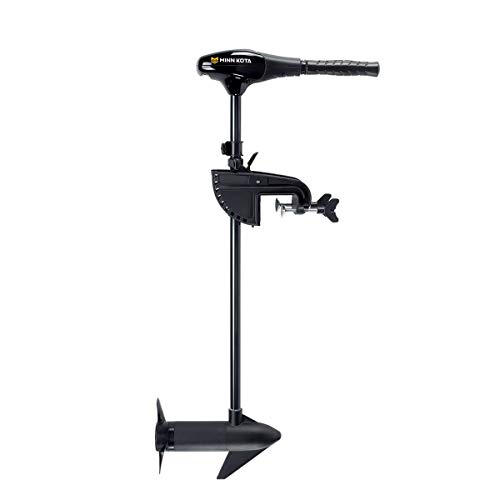
A 12V transom-mount motor with 40 lb of thrust and a 36-inch shaft, suited to small boats, canoes and jon boats. It has five forward and three reverse speeds, a six-inch telescoping tiller and a 10-position lever-lock bracket for quick height changes.
It is a freshwater model, so it is not the right choice for saltwater use.
Best For: Small freshwater boats that need a simple, well-supported tiller motor.
Newport Kayak Series 55lb Thrust Transom Mount Trolling Motor
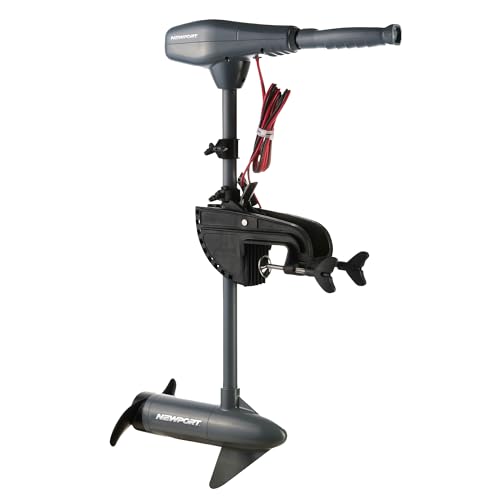
Newport designed this 12V motor for kayaks and canoes. It gives 55 lb of thrust with five forward and three reverse speeds, and the six-inch telescoping handle makes steering easier from a seated position.
It is saltwater-rated, with corrosion-resistant hardware, and the 4 ft 6 in battery cables give flexibility in where you place the battery. An LED indicator shows remaining battery power.
Best For: Kayaks, canoes and small boats used in fresh or salt water.
Factors to Consider When Choosing a Transom Mount Trolling Motor
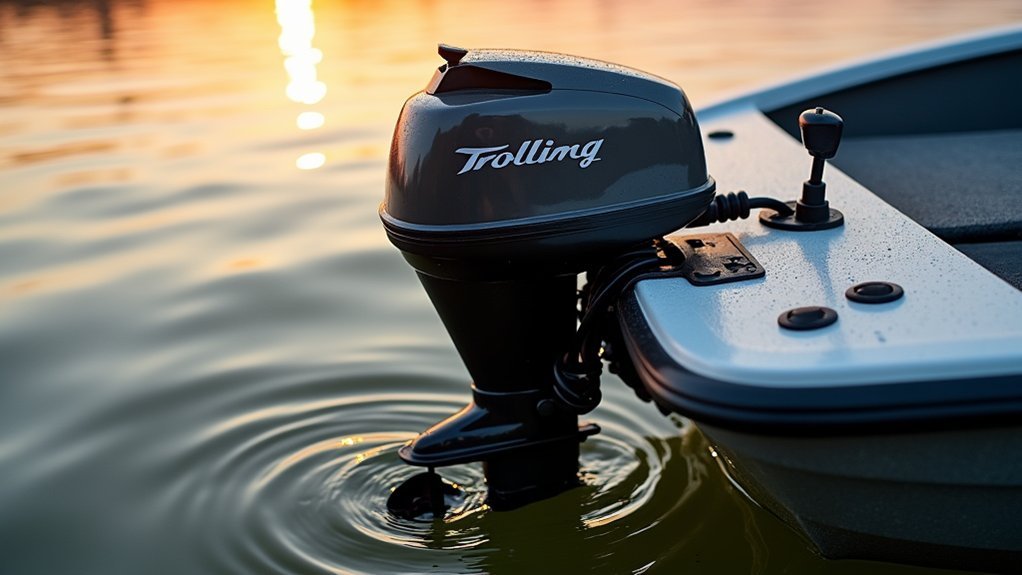
When choosing a transom mount trolling motor, you’ll walk you through key considerations including thrust power, battery voltage, and freshwater versus saltwater compatibility. It’s worth matching shaft length to your boat’s measurements and exploring speed control options that align with your fishing style. These factors will greatly/vastly/substantially impact your motor’s performance, longevity, and suitability for your specific boating needs.
Thrust Power Requirements
Understanding thrust power requirements stands as the cornerstone of selecting the right transom mount trolling motor for your boat. Anglers often find that matching thrust to boat size is critical—a mismatch can leave you struggling against currents or wasting battery power.
For small boats up to 12 feet, a 30 lb thrust motor typically suffices. If you’re operating a mid-sized vessel between 14-18 feet, you’ll want to examine 40-55 lb thrust options. Boats exceeding 18 feet generally require 55+ lbs of thrust to maintain proper control.
Don’t just examine size, though. I always remind boaters to factor in local conditions like wind and currents. If you frequently navigate choppy waters or face strong winds, It’s worth stepping up to the next thrust level for better maneuverability and peace of mind.
Battery Voltage Compatibility
Battery voltage compatibility ties directly into your trolling motor’s performance capabilities. Most transom motors operate on either 12V, 24V, or 36V systems, with higher voltages delivering more power and runtime.
For casual fishing on small lakes, a 12V system paired with a single deep-cycle marine battery is typically sufficient. If you’re handling larger boats or need extended operation, consider 24V systems requiring two batteries wired in series.
It’s worth matching your voltage choice to your thrust requirements—generally, motors over 55 pounds of thrust require 24V or higher. Remember that higher voltage systems demand more battery investment and maintenance, but reward you with longer runtime and consistent power output when you need it most.
Always check manufacturer specifications to guarantee proper electrical compatibility before purchase.
Freshwater Vs Saltwater
The operating environment for your trolling motor drastically affects which model you should select. If you’ll be boating in saltwater, you need a motor specifically designed for these harsh conditions.
Saltwater trolling motors feature stainless steel and magnesium components that resist corrosion, along with specialized waterproof electrical systems. They’re built to withstand the punishing effects of salt, but this durability comes at a elevated price point.
Freshwater motors are lighter and more affordable since they don’t need the same level of protection. While you can use a freshwater motor in saltwater occasionally, you’ll markedly shorten its lifespan without meticulous cleaning after each use.
I always recommend investing in a saltwater-rated motor if you’ll spend more than a few days per year in saltwater environments.
Shaft Length Options
Selecting the right shaft length is one of the most pivotal decisions when purchasing a transom mount trolling motor. Typical options range from 24 to 52 inches, each designed for specific boat types and water conditions.
We recommend longer shafts (40+ inches) for larger boats or if you frequently navigate choppy waters. The extra length keeps your propeller fully submerged even when bouncing through waves, maximizing thrust and control.
For kayaks, small inflatables, or calm water fishing, a shorter 24-30 inch shaft is ideal. It’s more manageable and reduces unnecessary weight.
If you’re unsure, consider models with adjustable telescoping shafts. Anglers often find these particularly valuable as they let you adapt to changing conditions without compromising performance or safety.
Speed Control System
Modern trolling motors offer three distinct speed control configurations that dramatically affect your fishing experience. Anglers often find digital stepless controls to be the gold standard, giving you infinite speed adjustments in both forward and reverse. This precision lets you match your trolling speed perfectly to fish activity and water conditions.
The best models now feature brushless motors paired with digital controls, delivering whisper-quiet operation that won’t spook fish. A highlight is how these systems provide smoother acceleration and deceleration compared to traditional preset speeds.
Look for models with intuitive smart interfaces built into the handle. These user-friendly controls let you make micro-adjustments without taking your attention off fishing. When you’re working a productive area, having fingertip access to precise speed control becomes invaluable for maintaining your perfect position.
Conclusion
I’ve guided you through these top-tier transom mount trolling motors, each cutting through water with precision and power. Whether you’re gliding across a misty lake at dawn or traversing choppy coastal waters, the right motor transforms your experience. You’ll picture you at the helm, confidently controlling your boat with whisper-quiet efficiency. Choose wisely, and you’ll feel that perfect harmony between boat, motor, and water.